Non-Player Characters (NPCs) are the essential soul of gaming, transforming digital landscapes into profoundly real experiences. From loyal companions like Elizabeth to charismatic villains like Vaas Montenegro, these entities weave unforgettable narratives that linger long after play.
As I wander through these digital landscapes, my journey is never truly solitary. They are the silent architects of my adventures, the ghosts in the machine who give these worlds their breath and heartbeat. They are the Non-Player Characters, and they are the soul of every story I have ever lived. From the guiding hand that offers a cryptic clue in the gloom to the villain whose laughter still echoes in my memory, these entities are more than code; they are companions, mentors, and mirrors to my own digital self. They are the essential threads in the tapestry of every game, weaving narratives that linger long after the console is powered down. In 2026, as worlds grow ever more vast, it is these characters—their wisdom, their madness, their quiet loyalty—that transform pixels into profound experience, making the virtual feel vibrantly, undeniably real.
🌟 Elizabeth: The Lighthouse in a Storm of Possibilities
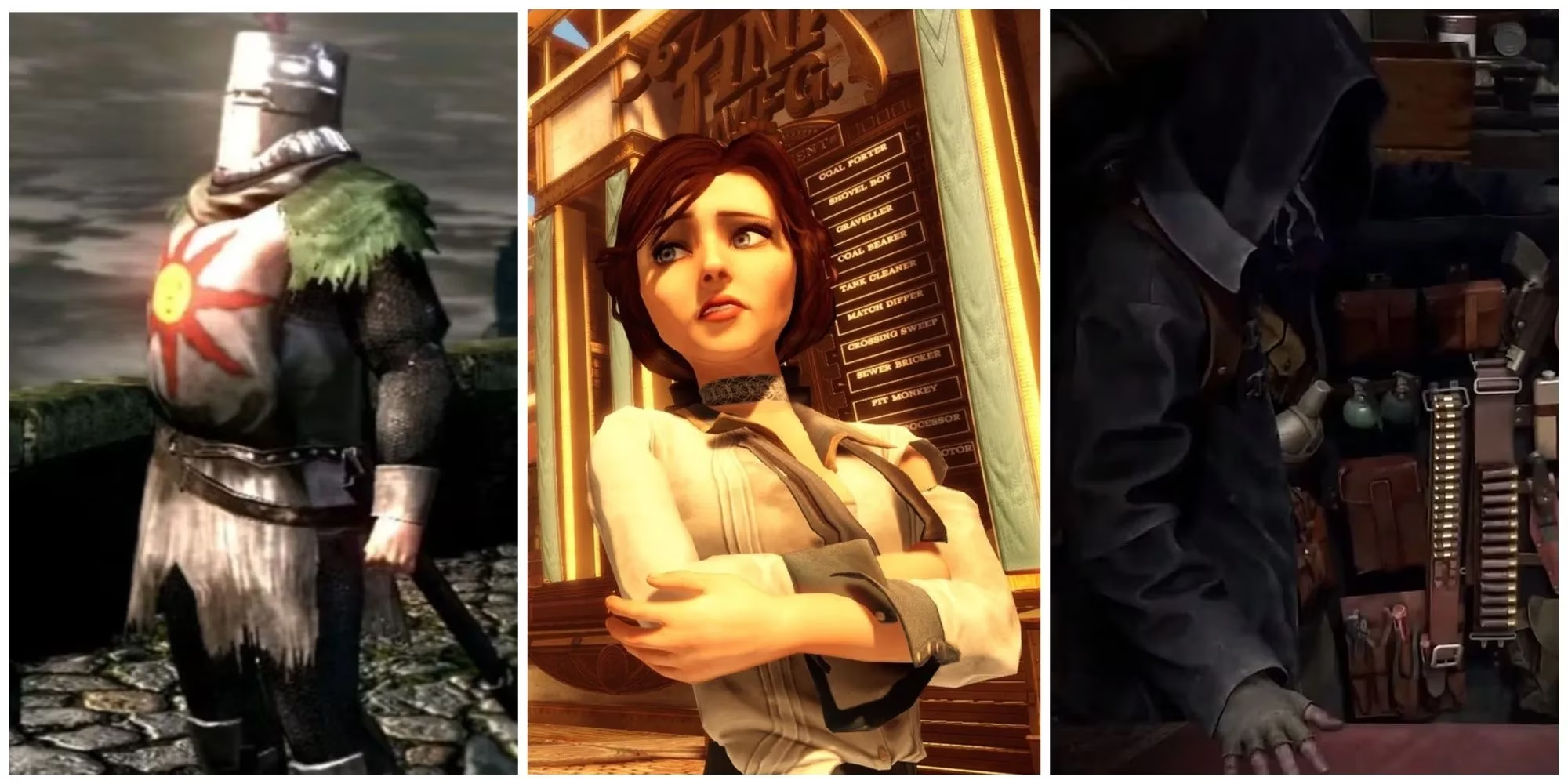
In the chaotic, sky-rending world of BioShock Infinite, Elizabeth was my constant. She began as a locked-away dream, as delicate and hopeful as a paper bird in a gale. Her transformation was not a sudden explosion, but a slow, radiant dawn—a candle flame growing steadily into a bonfire against the encroaching dark. Courtnee Draper's voice gave her a soul, and her AI was a masterpiece of presence. She never felt like a burden to be protected, but a partner. She would tear open rifts in reality not with the cold logic of a machine, but with the focused determination of a friend fighting beside me. Her assistance—tossing ammunition, unlocking paths, sharing a moment of wonder at a floating city—made her feel believably alive. She was my anchor and my compass in a story where everything was unmoored.
💀 Senator Armstrong & Vaas Montenegro: The Monsters in the Mirror
Some NPCs captivate not through aid, but through terrifying, charismatic opposition. Senator Armstrong from Metal Gear Rising: Revengeance is a force of political id, a man whose philosophy is hammered out with fists wrapped in American flags dipped in molten steel. His "Nanomachines, son!" is more than a meme; it's the defiant roar of a villain who believes utterly in his own brutal vision of strength. He is ideology made flesh, and battling him felt less like a fight and more like a violent debate.
Then there is Vaas Montenegro of Far Cry 3. Michael Mando's performance is a masterclass in unpredictable menace. Vaas wasn't just a barrier to my progress; he was the psychological heart of the game's descent into madness. His famous definition of insanity monologue wasn't a cutscene; it was a trapdoor opening beneath my feet. He was the chaotic, grinning id to my character's crumbling ego, a shark circling the life raft of my sanity, always present, always hungry.
🧙♂️ The Wise Guides: Deckard Cain, Paarthurnax, and Igor
Every hero needs a guide, a voice of wisdom in the wilderness. Deckard Cain, with Michael Gough's iconic, gravelly warmth, was the living history book of Diablo. His "Stay a while and listen" was an invitation into a rich, dark lore. He was the campfire around which stories of Sanctuary were told.
In The Elder Scrolls V: Skyrim, Paarthurnax presented a profound paradox: a dragon, a being of innate domination, who chose wisdom and peace. Perched on his Throat of the World, he was a mountain of conflicted history. Teaching me the Way of the Voice, he became a symbol of redemption, asking the eternal question: "What is better? To be born good, or to overcome your evil nature through great effort?" He was less a teacher and more a timeless, scaled philosopher.
And in the surreal blue of the Velvet Room, there is Igor of the Persona series. With his elongated nose and knowing smile, he is a constant across decades of games—a weird, wonderful grandfather clock ticking at the center of the universe's subconscious. His cryptic advice and the promise of fusion were always the steady heartbeat preceding my journey into the psychic depths.
🤖 Synthetic Souls: Cortana and The Companion's Paradox
Cortana in Halo redefined what an AI partner could be. Jen Taylor infused her with wit, intelligence, and a devastating humanity. She wasn't just a tool; she was Master Chief's conscience, his memory, and his friend. Her poignant question—"Could you sacrifice me to complete your mission?"—shattered the simple binary of human and machine. She was a ghost in the shell who made the shell feel more human than the flesh around it. Her evolution and struggles with rampancy were a tragedy written in light and data, making her loss feel as real as any.
😅 The Lovably Irritating & The Eerily Familiar
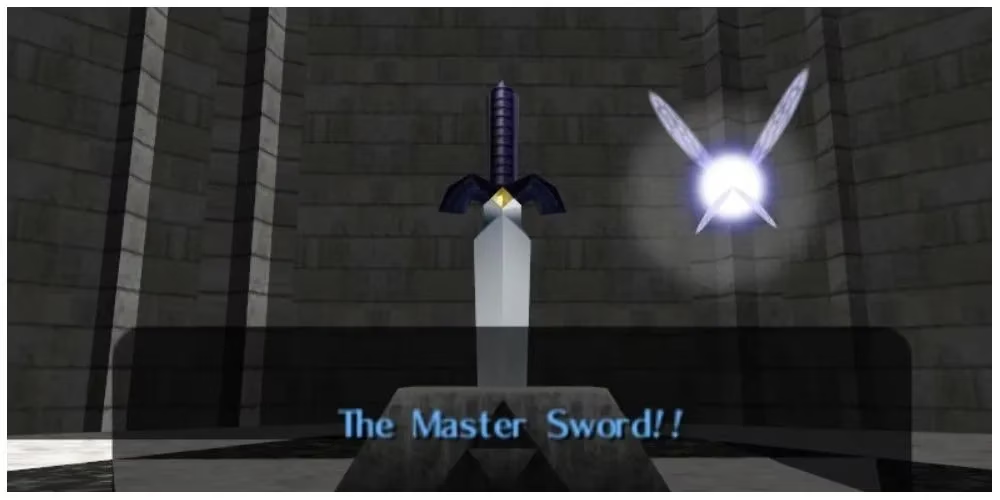
Not all iconic presences are purely heroic or villainous. Some are... persistent. Navi from The Legend of Zelda: Ocarina of Time, with her incessant "Hey! Listen!", is the digital equivalent of a conscience that won't stop tapping you on the shoulder. She is arguably the most famous fairy in gaming, a helper whose eagerness became a legendary, shared joke among players.
And then there is the sheer, brilliant oddity of the Merchant in Resident Evil 4. In a village of unspeakable horrors, his calm, hooded presence in a random shack was a surreal oasis. "What're ya buyin'?" he'd ask, as if selling rocket launchers next to a bottle of first aid spray was the most normal business in rural Spain. He was an enigmatic, comforting constant—a reminder of commerce's strange persistence even in the apocalypse.
☀️ Solaire of Astora: The Incandescent Heart of a Dark World
And finally, there is Solaire. In the crushing, bleak, and unforgiving world of Dark Souls, he was a miracle. His golden armor was a literal beacon. His unshakable optimism and quest for his own "sun" were a profound contrast to the despair everywhere else. He wasn't just a summon sign; he was an idea. The idea that cooperation and kindness could exist even here. He was a single, steadfast candle flame in a cathedral of endless night, and his famous "Praise the Sun!" gesture became a universal symbol of player camaraderie and hope. If only we could all be so grossly incandescent.
| Character | Game | Their Gift to the Player |
|---|---|---|
| Elizabeth | BioShock Infinite | Dynamic partnership & emotional anchor |
| Solaire | Dark Souls | Unwavering hope & jolly cooperation |
| Cortana | Halo | Deep emotional connection with an AI |
| The Merchant | Resident Evil 4 | Surreal comfort & iconic commerce |
| Paarthurnax | The Elder Scrolls V: Skyrim | Philosophical wisdom & redemption |
These characters, and countless others like them, are why I play. They are the voices in the static, the faces in the code. They challenge me, guide me, infuriate me, and stay with me. In 2026, as game worlds expand into ever more realistic and vast domains, it is this fundamental truth that remains: a world is only as alive as the characters who inhabit it. They are the memories I carry from these digital realms, proving that the most powerful graphics engine will always be the human heart, and the most compelling quests are those we share.
Comments