Halo Infinite and Fortnite showcase the evolution of live-service games, but Halo Infinite's ambitious vision fell short of its decade-long promise.
Man, thinking about Halo Infinite today in 2026 hits different. It's crazy to look back at that initial promise—remember the hype after the 2020 gameplay reveal? 😮 It was supposed to be "the start of our platform for the future," the foundation for the next decade of Halo. They even said we wouldn't see another numbered title for ages. Everyone was buzzing, myself included! But here we are, and the reality... well, let's just say it's a far cry from the Xbox answer to Fortnite we were all secretly hoping for.
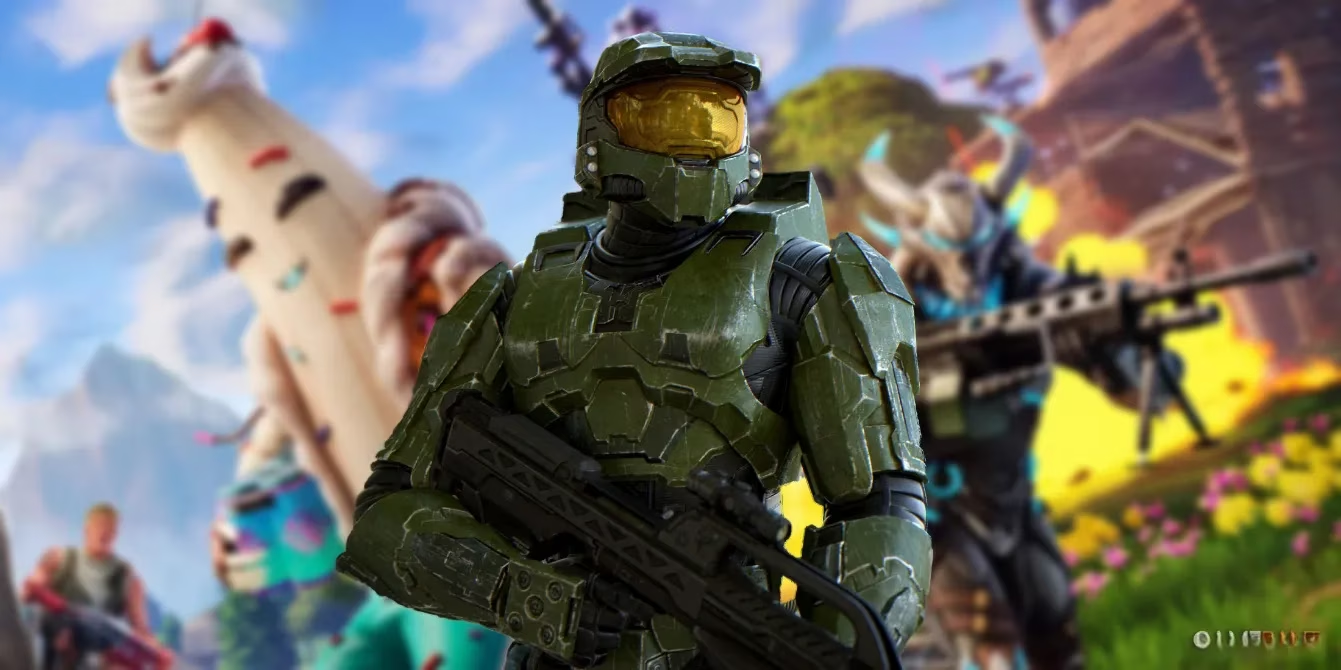
The Launch Honeymoon & The Live-Service Reality Check
Let's rewind. Back in 2021, the launch felt amazing! The multiplayer was a glorious return to classic arena shooter vibes, and the campaign's open-world approach felt fresh. Critics and fans alike were singing its praises. I spent hours just grappling around those first few maps. But as a live-service title, the cracks showed up way too fast. 🚨
-
Severe Content Drought: The map count was painfully low. Repeating the same few arenas got old quick.
-
Missing Core Features: Where was Forge? Where was campaign co-op? These weren't just nice-to-haves; they were Halo staples!
-
A Roadmap Full of Ghosts: The post-launch support felt inconsistent and slow. Player interest just... faded.
343 Industries has worked hard over the last few years to patch in those missing pieces, and I respect the grind. But by the time features like Forge 2.0 rolled around, a lot of the community momentum was already gone. It became about catching up, not building forward.
The Grand 10-Year Vision That Never Was
The real kicker is what could have been. They never spelled out the full 10-year plan, but reading between the lines, it was clear. This wasn't just a game; it was meant to be a growing, evolving platform. We were supposed to get:
-
Continuous Story Expansions: New narrative chapters dropping regularly, building on the Banished storyline.
-
Radical Multiplayer Evolution: New weapons, vehicles, and gameplay mechanics that would fundamentally change tactics over time.
-
Visual & Engine Upgrades: The Slipspace engine improving graphically year after year.
Instead of a one-and-done campaign, Halo Infinite's world was meant to be a living, breathing place we'd inhabit for a decade. Thinking about that lost potential still stings a bit.
The Fortnite Blueprint: A Glimpse into the Alternate Universe
This is where it gets truly mind-blowing. To understand what Halo Infinite might have become, you just have to look at Fortnite in 2026. Epic didn't just build a game; they built an entire universe inside a game. 🪐
| Fortnite's Evolution | Halo Infinite's Potential Parallel |
|---|---|
| Started as a PvE horde mode (Save the World) | Could have launched with a deep, Flood Survival mode |
| Became the world's biggest Battle Royale | Already had the core arena-shooter foundation to build upon |
| Added Creative Mode (player-made games) | Forge was the perfect seed for this! Imagine Halo's robust editor powering a whole creator economy. |
| Added LEGO Fortnite (survival/crafting) | Hello?! A Halo Mega Bloks/LEGO mode writes itself! Building bases, fighting Block Grunts. |
| Added Rocket Racing (arcade racer) | Imagine Warthog Rally Racing or Banshee Flight Simulator modes. |
| Added Fortnite Festival (music/rhythm game) | A Halo-themed rhythm game with the iconic Marty O'Donnell soundtrack? Take my money! |
Each of Fortnite's modes is essentially a free, standalone game living under one roof. Halo had all the ingredients to do the same:
-
Iconic IP with deep lore
-
Beloved sandbox of weapons and vehicles
-
Dedicated, creative fanbase
They could have transformed the Tactical Slayer (SWAT) into a hardcore tactical shooter mode. Firefight could have evolved into a massive PvE experience. The potential was literally universe-sized.
Why It Didn't Happen & The Legacy in 2026
So what went wrong? The vision was there, but the execution stumbled out the gate. Releasing without key features meant they spent years playing catch-up instead of innovating. The live-service model requires relentless, confident content drops, and Halo Infinite's pipeline just couldn't keep up initially. By the time they stabilized, the window to pivot into a true multi-game platform had likely closed.
Looking at it now in 2026, Halo Infinite stands as a fascinating "what if" in gaming history. It's a solid, fun Halo game that recovered from a rocky start. But the dream of it being a decade-defining platform—a hub for all kinds of Halo experiences—that dream quietly faded into the slipstream. We got a good game back from the brink, but we'll always wonder about the iconic platform we never got to see. It's a reminder that in live-service gaming, the launch isn't the finish line; it's just the starting gate, and you have to sprint from day one. 🤖💔
Comments