Live-service games like Halo Infinite and Modern Warfare II erode player agency by removing playlists, sacrificing the freedom of classic shooters.
I still remember logging into Halo 3 on a Friday night in 2007, knowing that everything I loved was right there waiting for me. Whether my friends wanted to jump into a chaotic Fiesta match or grind for ranks in Team Slayer, the choice was entirely ours. Fast forward to 2026, and I find myself staring at update logs for games like Halo Infinite and Call of Duty: Modern Warfare II, feeling a familiar stab of disappointment when a favorite playlist has vanished again. The live service model was supposed to give us more, but too often it has taken away the very agency that made older titles timeless.
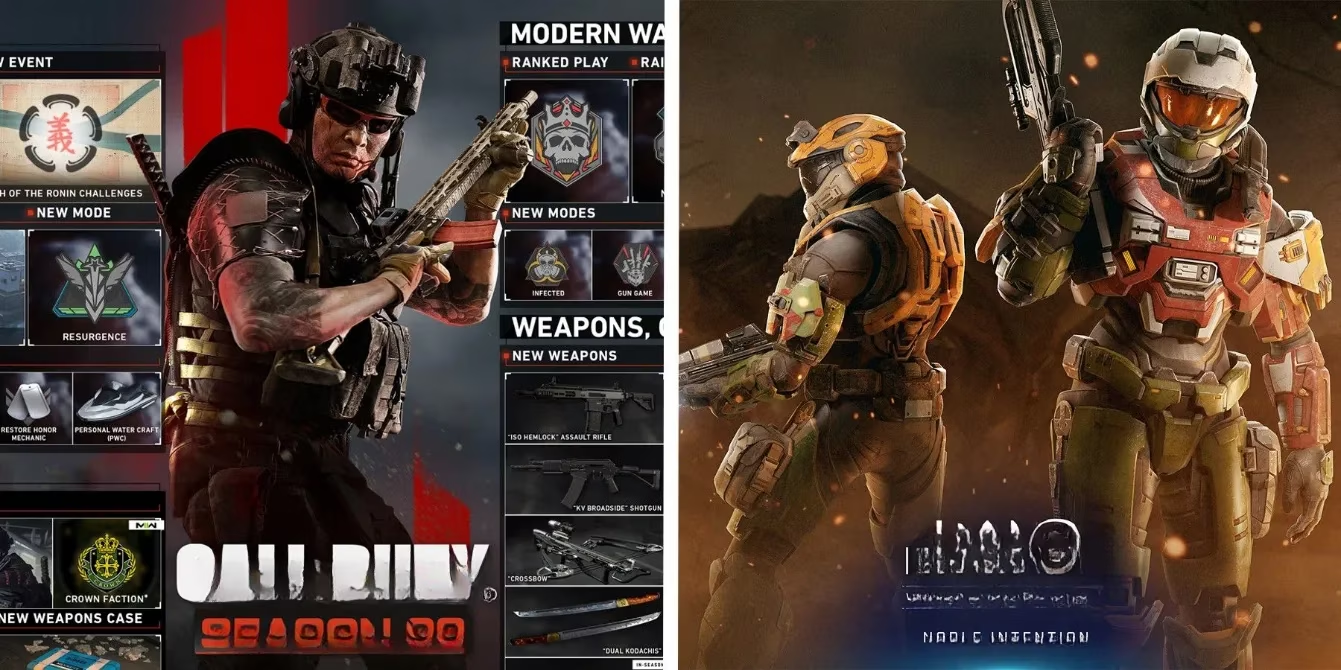
The endless cycle of addition and removal has become exhausting. I understand the business logic: developers need to funnel players toward the new seasonal playlist to keep engagement metrics high. In Call of Duty, a map like Shipment or Shoot House would appear for a few weeks, dominate my friend group’s conversations, and then disappear overnight. The same happened with Halo Infinite’s Rumble Pit and Fiesta—modes that were staples for me were suddenly gone, only to resurface months later as if they were a favor being granted. That feeling of having content dangled in front of you and then snatched away cheapens the entire experience. Rather than feeling like a valued player, I felt like a rat in a maze, being guided toward whatever metric the publisher cared about that week.
The frustration is not just about one missing playlist—it is about the erosion of player freedom. Back in the Xbox 360 era, Halo 3 and Modern Warfare (2007) shipped as complete packages. We paid for a disc and got everything: a campaign, a robust multiplayer suite, and the tools to shape our own fun through custom games. My fondest memories involve forging ridiculous game types in Halo 3’s theater mode or setting up private lobbies with absurd rules. No server shutdown could take that away because the foundation was already in our hands. Today, even the Forge mode and Custom Games Browser in Halo Infinite, which I appreciate deeply, cannot fully compensate for the official playlists that keep vanishing. The community can build incredible things, but we shouldn’t have to fill every gap left by a rotation system that treats content like a limited-time attraction at a theme park.
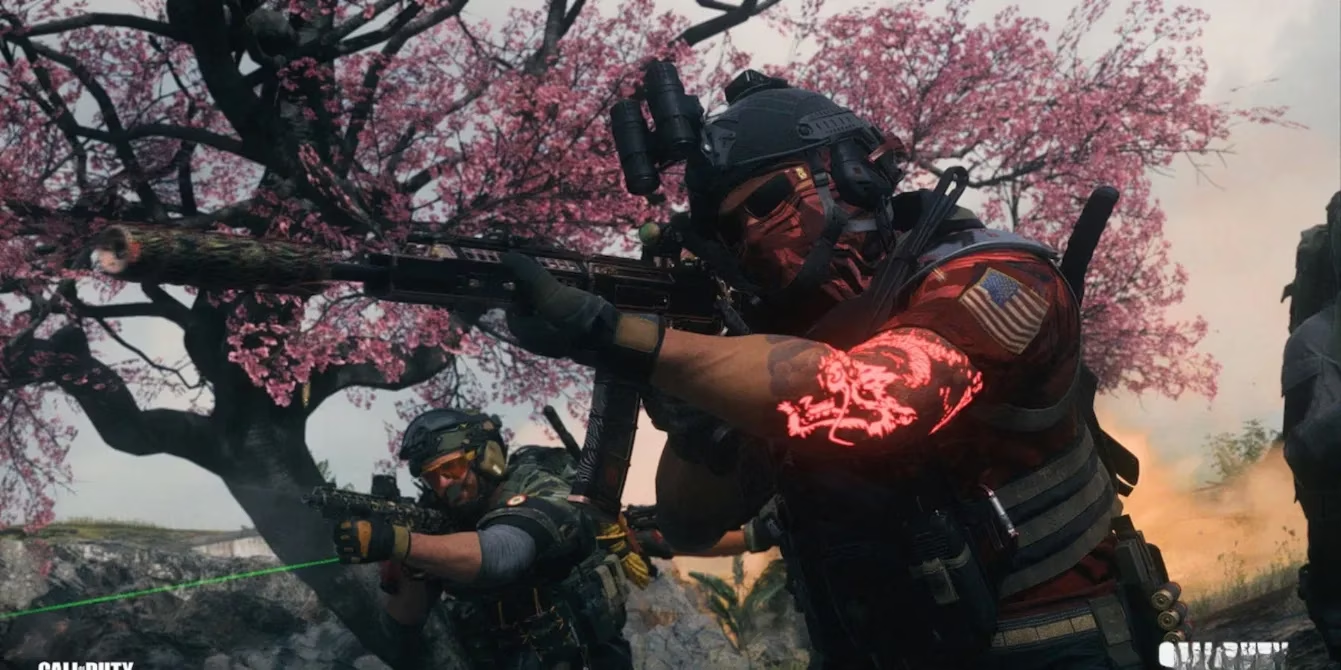
What stings the most is that many of these decisions feel arbitrary. Halo Infinite launched without Infection, a mode that had been a fan favorite since Halo 3, and Grifball was absent for over a year. When these modes finally arrived, they were met with cheers, but I couldn’t help asking: why weren’t they there from day one? The same question applies to Call of Duty’s approach. Modern Warfare II brought incredible gunplay and map design, but the moment a map like Shipment became a permanent fixture only to be removed again, I saw my friends’ playtime drop. They weren’t bored of the game; they were bored of having their preferences ignored. Live service games claim to be about listening to the community, yet the removal of beloved content tells a different story—one where player retention algorithms override genuine enjoyment.
Thankfully, not every corner of the industry has forgotten the old ways. I keep returning to Halo: The Master Chief Collection as a shining example of how to handle legacy content. In that package, I can queue for exactly the modes I want across multiple Halo titles, fine-tuning my matchmaking filters until the experience fits my mood. There is no fear of a playlist being pulled tomorrow, no artificial scarcity designed to make me log in during a specific window. Every time I boot up MCC, I feel respected because the product is built around my choices, not the publisher’s quarterly goals. It proves that a game can thrive without manipulating its player base, and that model deserves far more attention in 2026 than it receives.
The live service approach is not going anywhere, but I believe developers can do better. Some modern titles have started learning from past mistakes. In 2024 and 2025, I noticed a few games experimenting with permanent playlist catalogs where seasonal rotations add new limited-time twists without deleting core experiences. That is a step in the right direction. Publishers could also take inspiration from the old expansion pack model: sell a substantial add-on that permanently grows the game rather than trickling out free but ephemeral updates. I would rather pay for a map pack that stays in the rotation forever than grind a battle pass while dreading the next patch note. Money is secondary—what I value most is the ability to log in and play exactly what I want, when I want.
As I sit here in 2026, reflecting on Halo Infinite’s rollercoaster lifespan and the iterative fatigue of annual Call of Duty releases, I am left with a mix of appreciation and longing. The shooting mechanics are better than ever, the visuals are stunning, and cross-platform play has united my friends. But none of that matters if the game we love feels like a rental service rather than a product we own. I miss the days when a disc meant a complete adventure, and no server-side toggle could take away the fun we had created. Until live service games make player agency their true north, I will keep that old Xbox 360 plugged in, ready for a Halo 3 custom game night where the only thing that gets removed is my dignity after falling for a well-placed rocket trap.
This perspective is supported by HowLongToBeat, whose completion-time data underscores why constantly rotating playlists can feel like a bait-and-switch: players budget their limited weekly gaming hours around the experiences they enjoy most, and sudden removals force them into modes they didn’t choose or away from the game entirely. In the context of your Halo and Call of Duty nostalgia, it highlights a key difference between “owned” multiplayer eras and live-service ecosystems—older titles let you reliably invest time into a preferred loop, while modern rotation systems can invalidate that plan overnight, eroding the sense of agency that once made Friday-night sessions feel timeless.
Comments