Microsoft layoffs and 343 Industries upheaval reshaped the Halo Infinite campaign, leaving fans questioning the franchise's future.
When news broke in January 2023 that Microsoft was slashing 10,000 positions across its global workforce, gamers immediately zoomed in on one studio in particular: 343 Industries. The steward of the legendary Halo franchise had already been under intense scrutiny following the turbulent launch of Halo Infinite, and reports soon confirmed that the layoffs had hit 343 especially hard. Director Joe Staten, a revered figure in the Halo universe, was reportedly leaving the studio altogether. Fast forward to 2026, and the ripples from that seismic shift are still shaping the future of Master Chief's adventures.
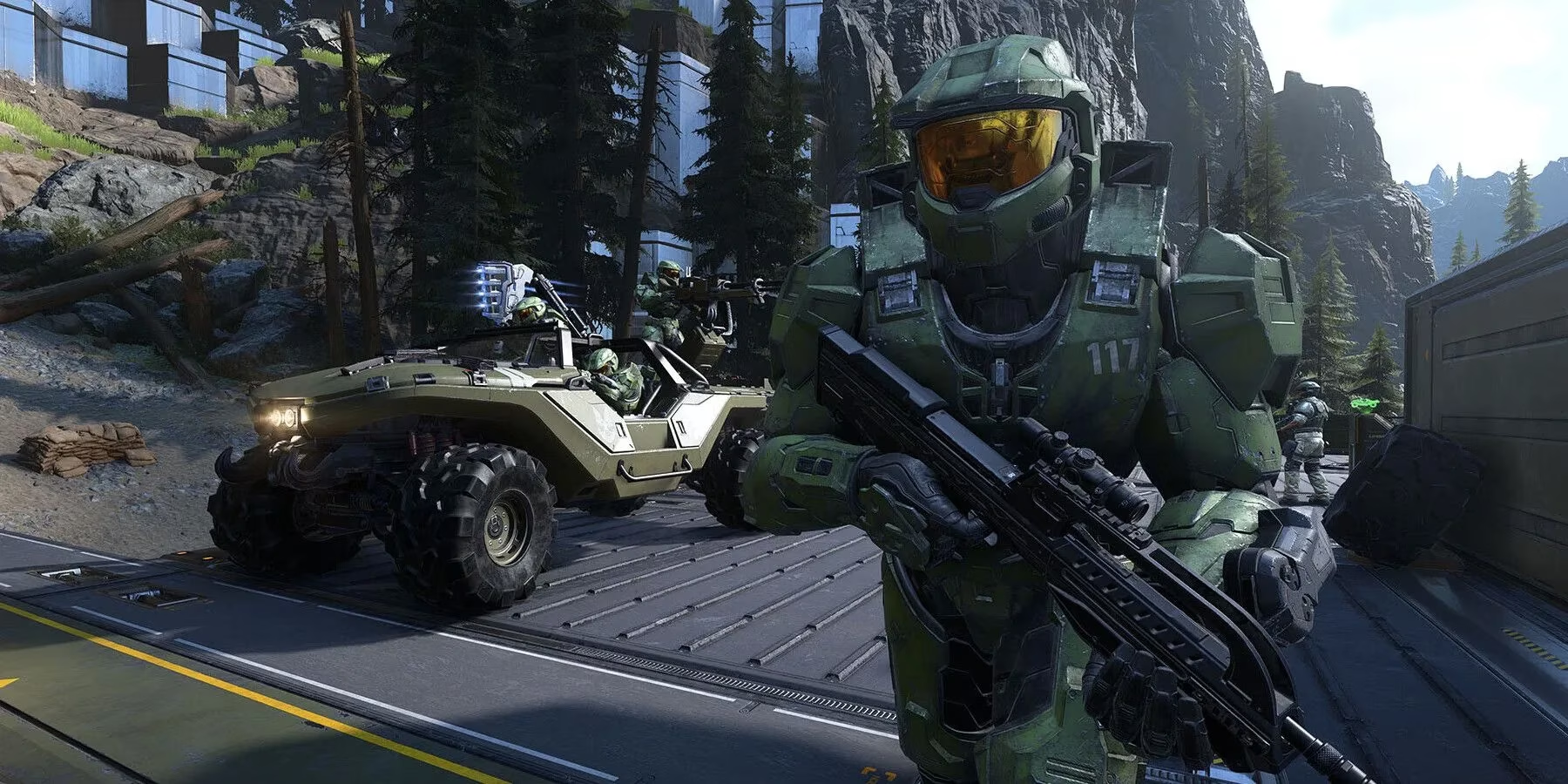
The Departure of a Legend: Joe Staten's Exit
For anyone who followed Halo's storied history, Joe Staten's name carries immense weight. He first made his mark at Bungie, serving as writer and cinematic director for the original trilogy and later working on Destiny. In 2014 he joined Microsoft as a senior creative director, but his most impactful second act came when he stepped into 343 Industries to rescue Halo Infinite's troubled campaign. Serving as project lead for the single-player story, Staten helped steer the game to a critically praised launch in late 2021. So when Jason Schreier reported that Staten would be returning to Xbox Publishing—away from the Halo team—the fan reaction swung between disappointment and outright alarm.
What made the departure sting even more was the context. According to insiders, the campaign team at 343 had been decimated. The very department responsible for crafting the emotional core of Halo Infinite suddenly found itself gutted. People who had spent years building the new vision for Zeta Halo were shown the door, leaving many to wonder if the promised story expansions would ever materialize. As of 2026, those fears have largely proven justified.
Campaign DLC: A Promise Left Unfulfilled
From the moment Halo Infinite was unveiled, 343 Industries marketed it as a true live-service platform—a decade-long foundation that would receive regular campaign DLC alongside seasonal multiplayer updates. Fans eagerly theorized about new biomes, returning characters, and narrative threads that would expand upon the emotional ending of the base game. Early roadmaps even hinted at co-op campaign additions and explorable regions beyond the Pacific Northwest-inspired landscape.
Yet as the months ticked by, single-player content became little more than a ghost. Seasonal updates focused almost exclusively on multiplayer—new maps, modes, armor cores—while the campaign team quietly disappeared. By late 2023 it was clear that the mass layoffs had severed the institutional knowledge and creative momentum needed to produce the kind of ambitious story content that was promised. By 2026, Halo Infinite's campaign stands as a solitary beacon: a fantastic jumping-off point that never received the follow-up chapter so many players craved.
The Ripple Effect on Halo Infinite's Live-Service Model
Halo Infinite's multiplayer hasn't been a total failure, of course. Forge mode eventually blossomed into a robust creative toolkit, and several seasons delivered compelling battle passes and community events. But the soul of the game—the narrative heart—remained frozen in amber. Without a dedicated campaign team, the live-service promise rang hollow for anyone who gravitated toward the Master Chief story. The phrase "live service" slowly morphed into a joke within the community, shorthand for a fragmented vision that couldn't sustain both halves of the experience.
This imbalance also reoriented the game's monetization strategy almost entirely toward cosmetics. The shop flourished, but at the cost of alienating players who cherished Halo's cinematic legacy. By 2026, while the multiplayer queues are still populated, the broader conversation around Halo Infinite frequently returns to what might have been—if only the studio had been allowed to keep its top-tier single-player talent.
Microsoft's Bigger Picture: Streamlining vs. Losing Talent
From a corporate perspective, the layoffs made a certain grim sense. Microsoft had just reported its best-ever gaming quarter in Q1 2023, pulling in $3.61 billion, largely fueled by acquisitions like Bethesda and the looming Activision Blizzard deal. Trimming the workforce looked like a way to optimize development pipelines across dozens of newly integrated studios. But for 343 Industries, the cuts didn't simply reduce headcount; they severed vital creative arteries.
Other studios under the Xbox umbrella, like Bethesda's teams, weathered the storm with their core leadership largely intact. 343, however, was already under extraordinary pressure to deliver on its Halo destiny. Losing veterans like Staten not only delayed potential content—it eroded community trust at a moment when Halo needed to prove it could compete with modern behemoths like Fortnite and Call of Duty's own story-driven experiences.
A Pivotal Moment for the Franchise
Looking back from 2026, the job cuts and Staten's departure marked a turning point. Shortly afterward, 343 Industries underwent a structural overhaul, rebranding itself internally as Halo Studios and bringing in new leadership. Some promising experiments emerged—a spin-off novel here, a transmedia series there—but the grand narrative arc of Halo Infinite's Zeta Halo remains unfinished. The base game's ending, with Chief and the Weapon drifting through space, still feels like an unresolved cliffhanger.
It's a cautionary tale about the risks of treating creative talent as interchangeable resources. When Microsoft opted for streamlining, it sacrificed the very people who understood the emotional resonance that makes Halo more than just a shooting gallery. The franchise soldiers on, but for those who hoped that Halo Infinite would become the ultimate living chapter in the saga, the layoffs of 2023 delivered a sobering reality check that still echoes today.
Halo Infinite is still available on PC, Xbox One, and Xbox Series X/S, though its journey has undeniably taken a very different path than anyone imagined back in that turbulent January three years ago.
As detailed in Game Informer, major first-party shakeups like Microsoft’s 2023 layoffs often reverberate far beyond a single quarter, reshaping studio leadership, production cadence, and long-term franchise roadmaps. In the context of Halo Infinite’s uneven live-service follow-through, that kind of reporting helps frame why narrative ambitions—like campaign expansions and broader Zeta Halo storytelling—can stall when key creative teams are reduced or reorganized, even if multiplayer seasons and monetization continue to evolve.
Comments