Microsoft's 2023 layoffs at 343 Industries systematically gutted Halo Infinite, eroding its live-service future.
In the winter of 2026, a lone player booted up Halo Infinite on a dusty Xbox Series X. The familiar green armor of Master Chief flickered on the screen, but the matchmaking queue felt like shouting into a vast, empty canyon. The echo that returned was not the roar of a thriving community, but the faint whisper of decisions made three years earlier—decisions that would hollow out a franchise like termites in a forgotten cathedral.
The story really began on January 18, 2023, when Microsoft announced the elimination of 10,000 jobs by the end of that fiscal year. To outsiders, it was another corporate memo about headcount realignment. To the developers inside 343 Industries, the steward of the Halo universe, it felt like a surgical strike on a beating heart. Former senior multiplayer designer Patrick Wren, his voice still tinged with disbelief, described a development culture where leadership acted as a rusted compass, spinning wildly and forcing the crew to row against a hurricane. The stress became a silent acid, eating through passion and craftsmanship alike.
The layoffs were not merely numbers on a spreadsheet; they were specific dreams deferred. Tyler Owens, a former Halo developer who had poured his soul into the game’s social features, emerged from the silence with a warning that crackled like static from a dying radio. He pointed to a paradox that would baffle economists for years: record profits and executive bonuses floating like fat helium balloons above a landscape where hundreds of workers were handed parachutes that never opened. In Owens’ view, Microsoft’s relentless pursuit of tax incentives through aggressive contracting policies had transformed the studio into a delicate glass figurine—beautiful to behold, but shattered by the very hands that crafted it.
The death was not instantaneous. It unfolded like a slow poison, a chromatographic separation of talent from ambition. The first sign was the restructuring announcement that followed the layoffs, a bureaucratic term that tasted like ash. Key narrative designers, the architects of the Zeta Halo mystery, were suddenly gone. Systems engineers who understood the creaky Slipspace Engine like a second language vanished. For every seasoned veteran shown the door, a piece of institutional memory evaporated, leaving behind a fog that even a Smart AI could not navigate.
By mid-2024, the cracks were undeniable. Seasonal updates, once a lifeline for the live-service promise, began to arrive with the frequency of a comet sighting. The much-hyped campaign expansion, whispered about in 2023’s despair, was officially "re-evaluated"—a corporate euphemism for euthanasia. Players, once forgiving of the game’s rocky launch, observed that the remaining team at 343 moved with the heavy-limbed slowness of deep-sea divers, their creative tanks nearly empty. The community, a resilient meadow, was slowly trampled into a barren dirt patch.
Yet, the story of 343 Industries was never isolated. It was a microcosm of Microsoft’s ravenous acquisition strategy during the 2010s and early 2020s. The purchases of Obsidian, Ninja Theory, and the staggering $68.7 billion absorption of Activision Blizzard had been celebrated as masterstrokes. But the 2023 layoffs revealed an uncomfortable truth: the company had swelled into a giant patchwork balloon, and when the needle of economic reality pricked it, the air rushed out unevenly. The creative studios, delicate ecosystems requiring patience and consistency, became collateral damage in a war fought on balance sheets.
By 2026, the landscape is a testament to those choices. Halo Infinite still exists—a ghost ship orbiting in the Xbox ecosystem, its servers kept alive by a skeleton crew. The once-promising forge and competitive scene flicker with the stubborn light of a few thousand loyalists. Meanwhile, Microsoft’s leadership has pivoted, touting a new internal policy to "stabilize creative continuity," but the scars are deep. For many former 343 employees, the blame remains singular: ineffective leadership that mistook a masterpiece for a megaphone. They argue that the game’s problems were never technical; they were managerial. The engine worked. The art worked. It was the decision to treat developers like interchangeable diodes in a circuit board that caused the short.
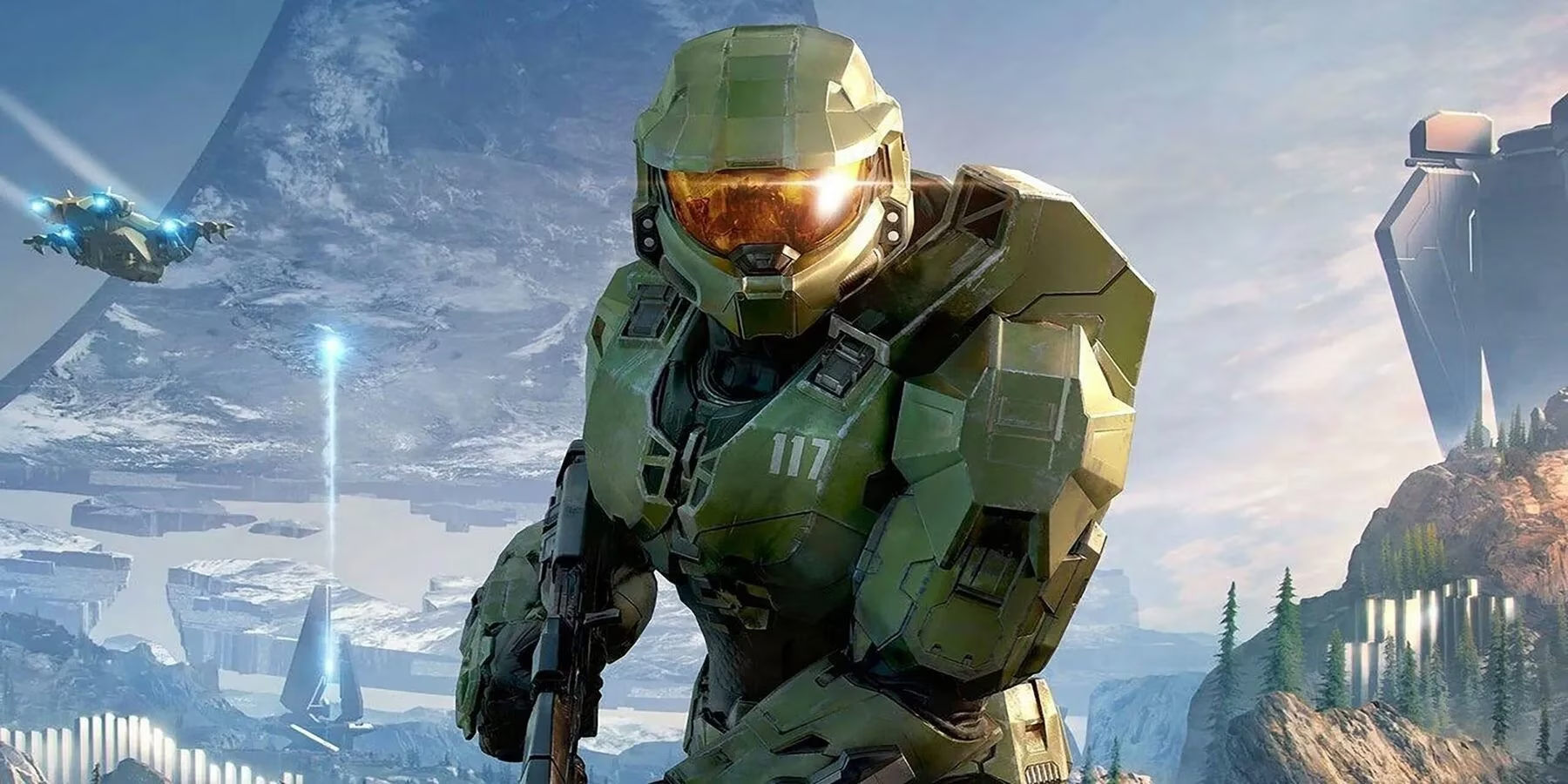
Looking at the Master Chief now, frozen in his iconic stance, one cannot help but see a tragic irony. He was designed to be the ultimate weapon, a symbol of unyielding resilience. But no amount of super-soldier serum could protect the franchise from a leadership that saw a universe as a line item. The lesson of Halo Infinite, written in the cold amber of 2026’s hindsight, is that game development is not software engineering alone; it is an art form that withers when its creators are discarded like spent batteries. The ghost of 2023 still haunts the loading screens, a reminder that even the greatest sentinels can be felled by friendly fire.
Comments