Fortnite's seasonal battle passes, a cornerstone of live-service gaming, drive player engagement through time-limited rewards. However, this model's pressure to complete content before expiration can alienate casual players, highlighting the need for a more inclusive, permanent battle pass system to unlock the game's full potential.
Battle passes have become a foundational element of the live-service gaming landscape, with Epic Games' Fortnite standing as one of its most prominent and widely recognized exponents. This monetization strategy has proven remarkably successful in sustaining player engagement and generating consistent revenue streams. Yet, beneath this surface success lies a persistent point of contention: the time-limited nature of these content bundles. While designed to foster constant activity, the traditional seasonal model, which sees coveted rewards vanish at the season's end, may ultimately be limiting Fortnite's potential to reach a wider, more diverse audience. As the gaming industry evolves, with successful examples like Helldivers demonstrating alternative paths, a compelling argument emerges for Fortnite to reconsider its approach and adopt a system of permanent battle passes.
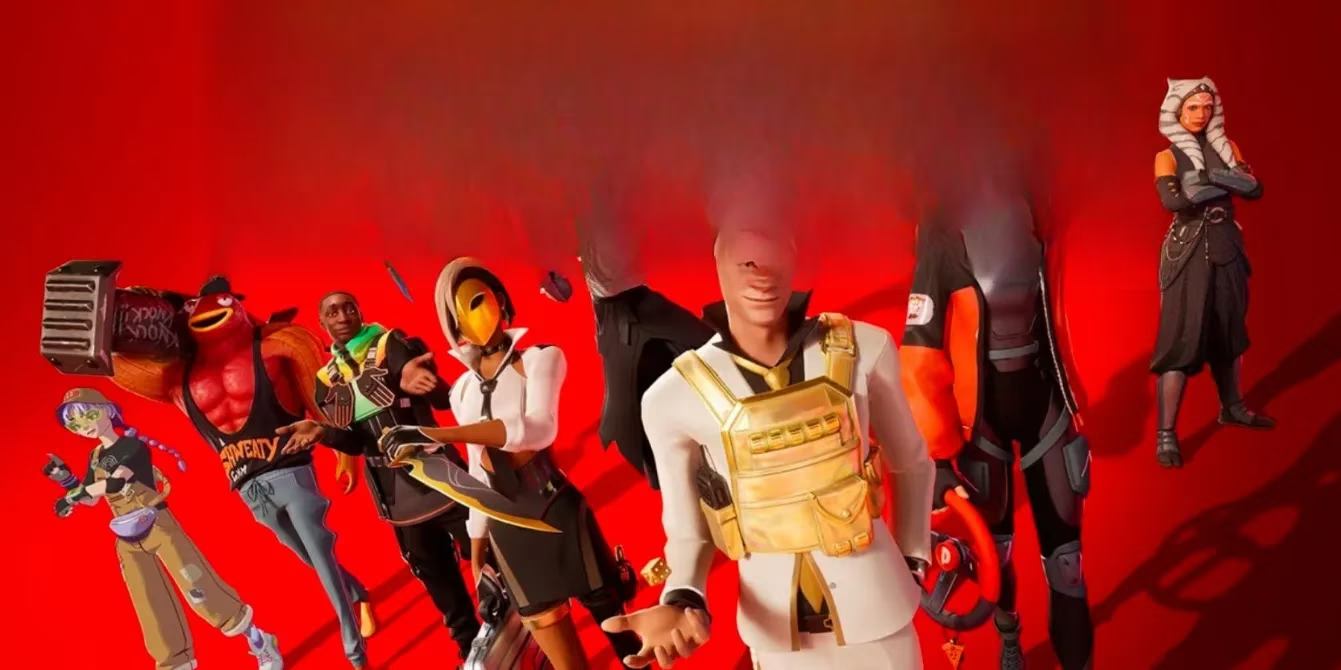
At its core, the Fortnite battle pass functions as a tiered progression system. Players, often after purchasing the pass, complete challenges and earn experience to unlock a cascade of rewards: V-Bucks (the in-game currency), an array of character skins, harvesting tools, emotes, and other cosmetic items. The system is engineered for retention, creating a compelling gameplay loop. However, the major catalyst for this engagement is the looming expiration date. Every cosmetic, every skin, every bit of currency tied to that specific pass will become permanently unavailable once the season concludes. This mechanism directly taps into a powerful psychological driver known in gaming communities as FOMO—the Fear of Missing Out. The anxiety of losing access to premium content for which one has paid creates a powerful incentive for near-constant play, transforming leisure into a perceived obligation.
For the most dedicated players, this time-sensitive structure can feel exciting—a series of limited-time events to conquer. Yet, for the vast majority of more casual participants, it often breeds a different sentiment. The battle pass, a product they've purchased, can begin to feel like a second job. The need to log in regularly and grind through challenges to "get their money's worth" before the clock runs out can strip the fun from the experience. This pressure acts as a significant barrier to entry and sustained investment for players who cannot or do not wish to dedicate large, consistent chunks of time to a single game. The consequence is a potential player base that feels excluded by the very system meant to include them.
The industry, however, has already provided a blueprint for a more player-friendly alternative. Prior to significant changes in its live-service approach, Halo Infinite offered a pioneering model: permanent battle passes. Players could purchase any active or previous season's pass and complete it entirely at their own pace. When a new season launched, a new pass became available, but progress on old ones remained intact and accessible. This model fundamentally respects player time and investment. More recently, the explosive success of Helldivers 2 has further validated this approach, demonstrating that a game can achieve massive popularity and player retention without relying on predatory FOMO tactics tied to battle pass expiration.
Adopting a permanent system in Fortnite would yield multifaceted benefits for both Epic Games and its community:
-
Reduced Player Anxiety & Burnout: Eliminating the seasonal time crunch would allow players to engage with the game on their own terms. Gaming would revert to a hobby of choice rather than a chore of necessity.
-
Broadened Appeal to Casual & New Players: Following major partnerships, like the landmark deal with Disney, Fortnite's goal is to expand its universe to an ever-wider audience. Casual players and even non-gamers intrigued by crossover IP are far more likely to invest in a battle pass if they know they can complete it over months or even years, not just a few frantic weeks.
-
Increased Perceived Value & Goodwill: A purchased battle pass becomes a permanent part of a player's account, significantly increasing its long-term value. This fosters greater consumer trust and goodwill, positioning Epic Games as a developer that respects its players' time and money.
-
Sustained Long-Term Engagement: While it might reduce the daily login metrics from a core group, it would encourage more consistent long-tail engagement from a larger overall population. Players could return to old passes during content lulls, maintaining a connection to the game.
Critics might argue that removing time limits could dampen the urgent engagement metrics that drive live-service success. Yet, this perspective may be shortsighted. Exchanging a voracious but potentially burn-out-prone core for a larger, more relaxed, and perpetually invested audience could be a net positive. Players who are not pressured by FOMO are more likely to make discretionary purchases simply because they want to, not because they feel they must to avoid loss. They become fans, not fixtures.
As of 2026, the conversation around ethical monetization and player-friendly design is louder than ever. Microtransactions and battle passes have faced valid criticism, but they need not be inherently antagonistic to consumer interests. Unshackling Fortnite's battle passes from their seasonal chains represents a progressive evolution. It is a change that acknowledges the diverse lifestyles of a global player base, prioritizes sustainable fun over compulsive engagement, and aligns with a future where live-service games are built to last with their communities, not just to exploit their time. By learning from the successes of others and listening to its own community, Fortnite has the opportunity to set a new, more respectful standard for the industry it helped define.
Comments