The Forerunners built Halo rings to eradicate the Flood, an act of omnicide that left humanity as inheritor of the Mantle.
Deep within the silent, drifting corridors of an ancient ringworld, a lone UNSC technician swept her scanner over a wall of glyphs that pulsed with a soft, bluish light. The symbols were not human, nor Covenant—they were older, far older, echoing from a time before recorded history. She felt a shiver as the translation software rendered a single line: The Mantle belongs to the inheritors. That message, etched across countless ruins across the galaxy, pointed to a species long vanished yet never truly gone: the Forerunners.
A hundred thousand years ago, the Milky Way belonged to them. The Forerunner ecumene stretched across star systems, a civilization of towering warriors and brilliant artisans who shaped matter and manipulated slipspace with an ease that later species could only chase in myth. They were the undisputed masters of technology, building shield worlds big enough to contain entire artificial stars, tombs that preserved the dead in crystalline stasis, and array after array of energy transmitters that could reshape a planet’s surface in a single command. Their pinnacle creations, however, were the Halos.
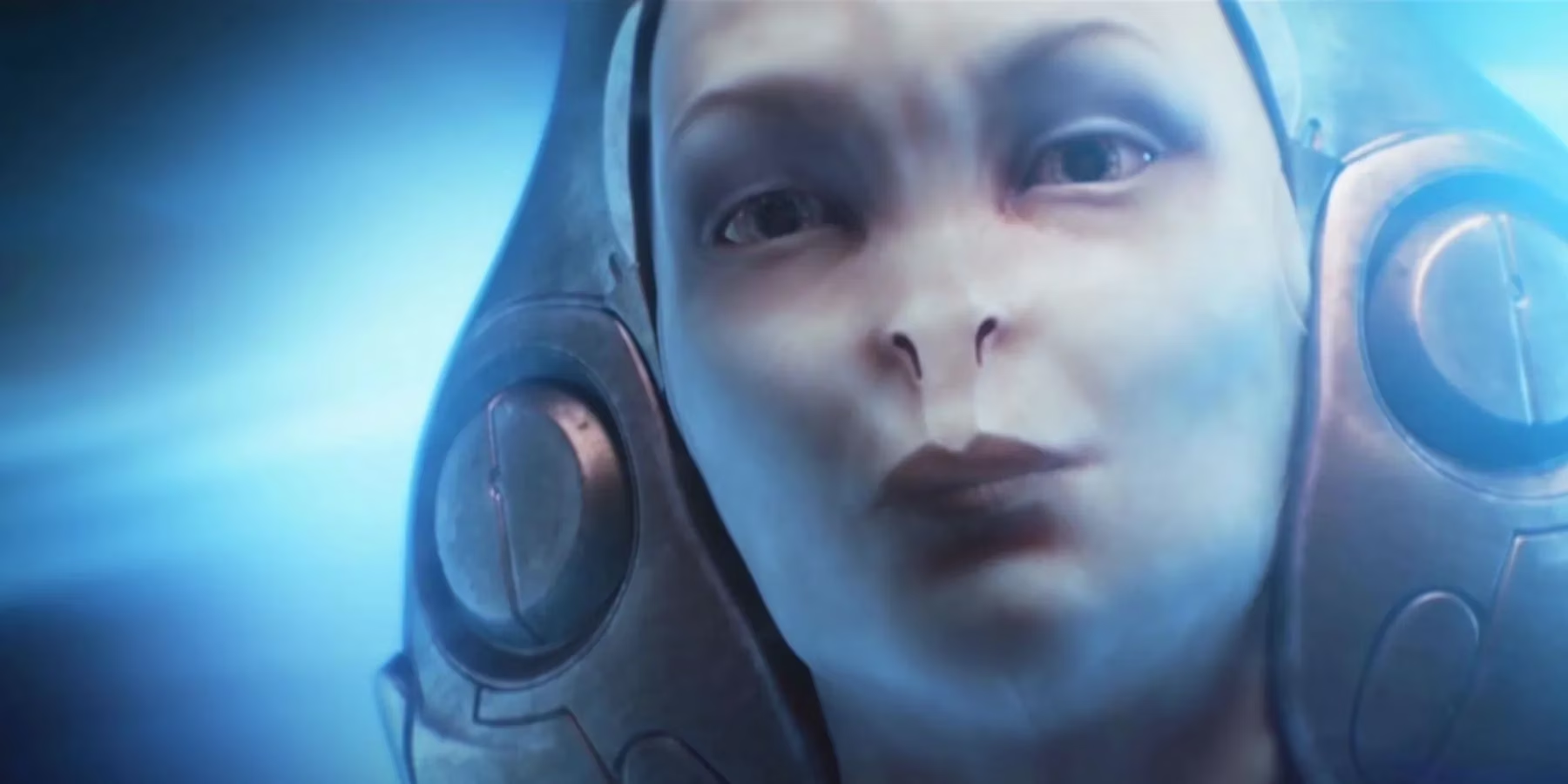
The crisis began with a spore. When the parasite known as the Flood seeped into Forerunner space, it twisted every being it touched into writhing monstrosities that hungered only to infect more. The Forerunners fought with all their might—Legions of Promethean Knights, squadrons of War Sphinxes, even star-busting weapons—but the Flood learned, adapted, and spread until entire solar systems collapsed into a groaning, organic horror. In desperation, the Forerunner leadership turned to a single, terrible solution.
They constructed the Ark, an immense shipyard hidden beyond the galaxy’s rim. There, Sentinels assembled twelve Halo rings, each a ringworld thousands of kilometers in diameter. Aligned in a precise configuration, the Halos would emit a cross‑phasic superluminal pulse capable of wiping out all sentient life within three radii of the galactic center—the Flood’s food supply included. The plan was nothing less than omnicide. But the Forerunners also copied the DNA of every known living species, storing the samples in the Ark and across automated facilities, ready to reseed the galaxy once the Flood starved. And in their final act, they made a fateful choice: humanity, not the arrogant Prophets or the servile Grunts, would inherit the Mantle of Responsibility. The Forerunners bestowed upon this primitive species the right and burden to safeguard the galaxy.
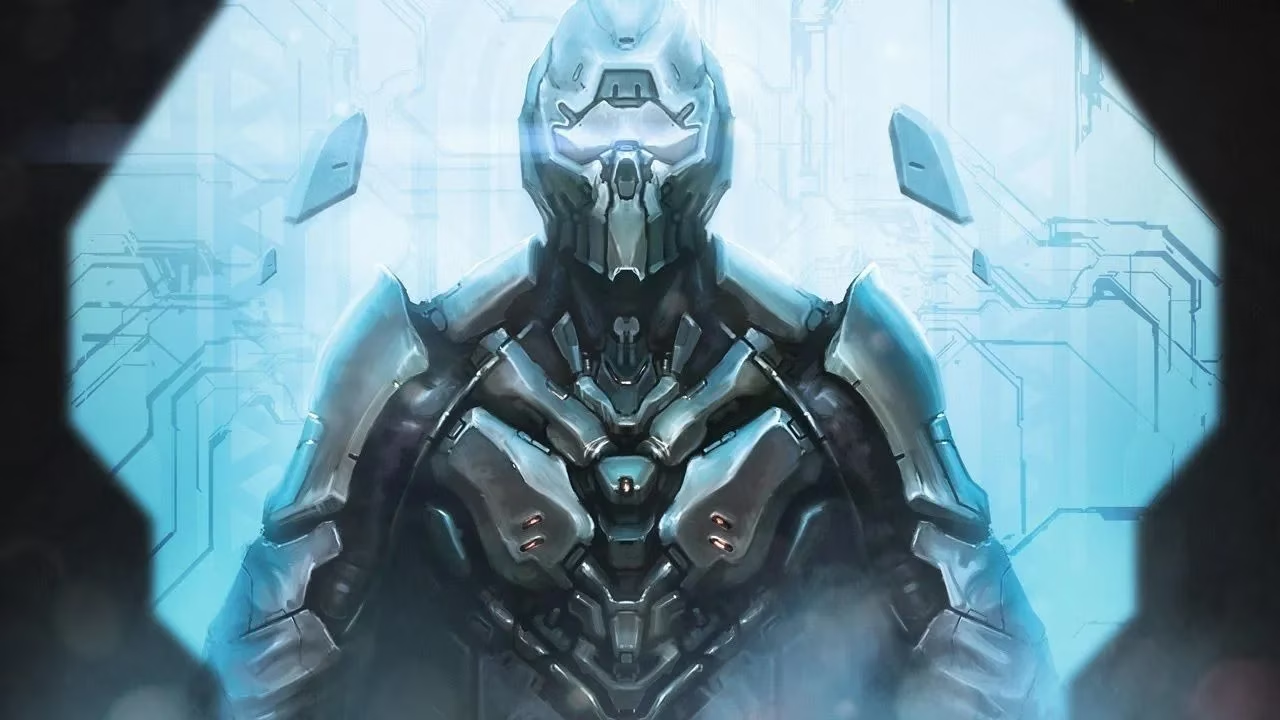
When the rings fired, a silent cataclysm swept across the stars. Every Forerunner, every Flood form, every overlooked species perished. Then, obediently, the systems activated, and life returned—first as seeds and plankton, then as fauna. Millennia later, humanity rose again, unaware of the ancient genocide and the mantle they carried.
For fans of the Halo saga, this backstory is not mere lore—it is the axis around which everything spins. Without the Forerunners, the Covenant would never have discovered the sacred rings they so fanatically worshiped. There would have been no reason for the Prophets to declare humanity an affront and launch the war that defined Master Chief’s entire existence. The Halos themselves, those glittering banded mysteries that dominate every game’s iconography, would simply never have existed. Cortana’s whispers on the first Halo ring, grasping at data she could barely process, all point back to the Forerunner mind. Every time a Spartan steps onto a strange installation and feels the hum of a long‑dormant machine, they are walking in Forerunner footsteps.
Over the years, however, the custodians of the franchise at 343 Industries have gingerly tried to pivot away from this foundational epic. Halo 4 plunged headlong into the Forerunner narrative, weaving the Didact’s personal war into Master Chief’s journey and confronting players with a direct descendant of that ancient race. It was an intimate, controversial chapter. Then Halo 5: Guardians pulled back, reframing the Forerunners less as inscrutable benefactors and more as warmongering relic‑keepers, highlighting their devastating Guardian constructs. The story seemed to deliberately fracture the inherited image.
With Halo Infinite, 343 introduced the Xalayn—an entirely new species poised as the primary threat, glimpsed in the game’s post‑credits scene in a chilling alliance with the Banished. Suddenly, the horizon belonged to a threat unrelated to the Forerunner legacy. On the surface, this was a bold escape, a chance to tell fresh stories unburdened by a ten‑thousand‑century genealogy. But the Halo universe resists such amnesia.
Every battle fought on Zeta Halo, every artifact that Atriox seeks to weaponize, every ancient mechanism that the Banished’s Huragok poke and prod—these all remain Forerunner in origin. The rings are Forerunner. The Quantum Slipspace technology is Forerunner. The very concept of the Mantle that motivates so many factions stems directly from Forerunner philosophy. To pretend the Forerunners do not exist would mean severing the franchise’s connection to its own stages, its own weapons, its own central mysteries.
By 2026, the conversation has only grown louder. New Halo projects teased by 343 Industries, influenced by live‑service innovations seen elsewhere, still cannot escape the shadow of those towering machines. Aspiring to a narrative like Call of Duty’s seasonal shocks might bring the Xalayn to the forefront, but even a completely original war will be fought on Forerunner ground. The Sentinels will still guard their installations. The Flood, should it ever truly return, will still speak with the voice of corrupted Forerunner science. And humanity, clutching its Mantle, will still be the inheritors.
The enduring truth for any player, whether they first entered the fray in 2001 or in 2026, is that the Forerunners refuse to be a mere prologue. They are the architecture beneath every corridor, the logic inside every artifact’s glow. 343 Industries can add new villains, new allies, and new galaxies, but forgetting the Forerunners is simply not possible—because Halo itself was their gift, and its story will forever echo with their vanished anthem.
Comments