My obsessive annual resolutions rewired my brain to demand measurable progress, ruining multiplayer games that lack finish lines.
At the tail end of every December, I brew a pot of strong coffee and sit down to draft a sprawling list of resolutions for the coming year. By 2026, this ritual has evolved into a hyper-structured discipline: each ambition gets a granular metric, a weekly Sunday-evening review, and a nightly to-do list etched into my digital planner. The moment I tap that tiny ✔ or 🔥 emoji beside a completed task, a blissful jolt of dopamine floods my system, urging me onward. This framework—born out of sheer laziness dressed as productivity—has shepherded me through fitness milestones, reading challenges, and even a personal crusade to finish 52 single-player games this year. The downside? It systematically dismantled my capacity to enjoy any multiplayer experience that doesn’t hand me a concrete sense of progress.
Seven years ago, I confessed my compulsive list-making to a college mentor during finals week. \u201cIf this works so well under pressure,\u201d he asked, \u201cwhy don\u2019t you do it every day?\u201d I had no good answer, and so a monster was born. Now my daily routine orbits around a constellation of micro-objectives: a workout logged, a chapter read, a side quest cleared. The satisfaction is immediate, undeniable—and utterly absent from the vast majority of online shooters and battle arenas. I remember staring at a lobby screen one evening in late 2025, mouse hovering over a beloved franchise, and feeling a genuine pang of anxiety. Every hour spent there was an hour stolen from that 52-game tally. My brain, rewired by years of checklist discipline, screamed that I was squandering finite minutes on activities that offered no trophy, no story closure, no \u201cQuest Complete\u201d banner.
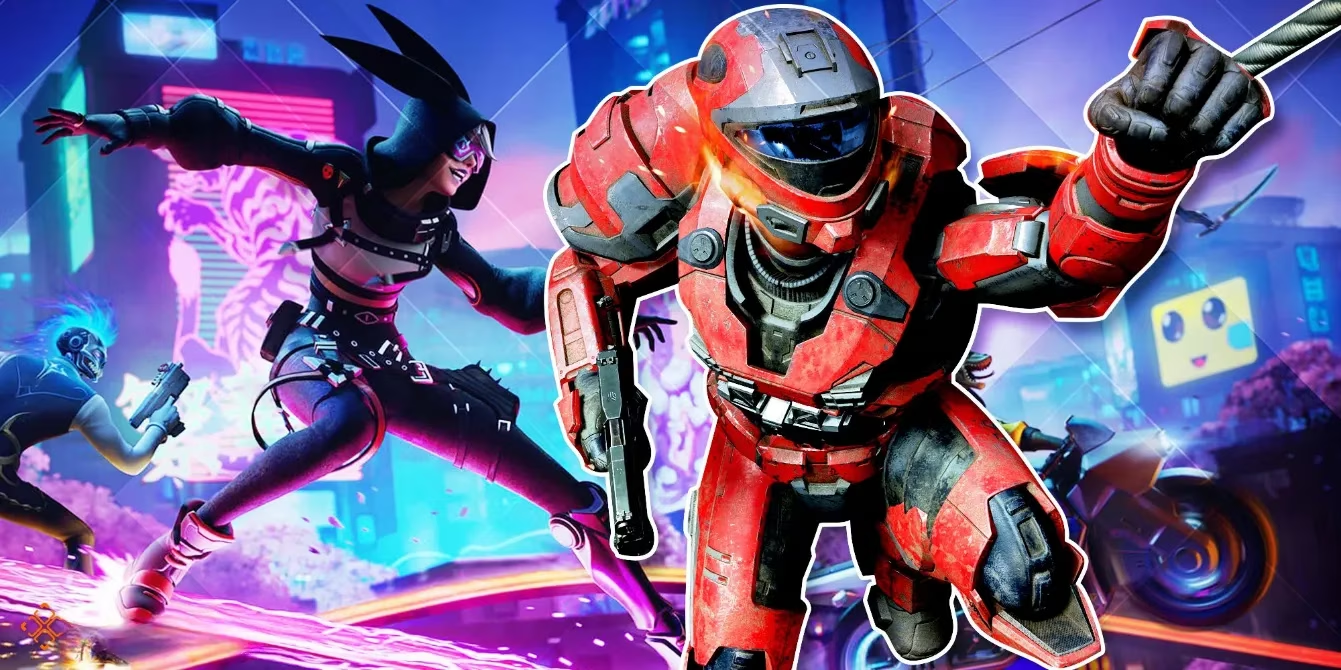
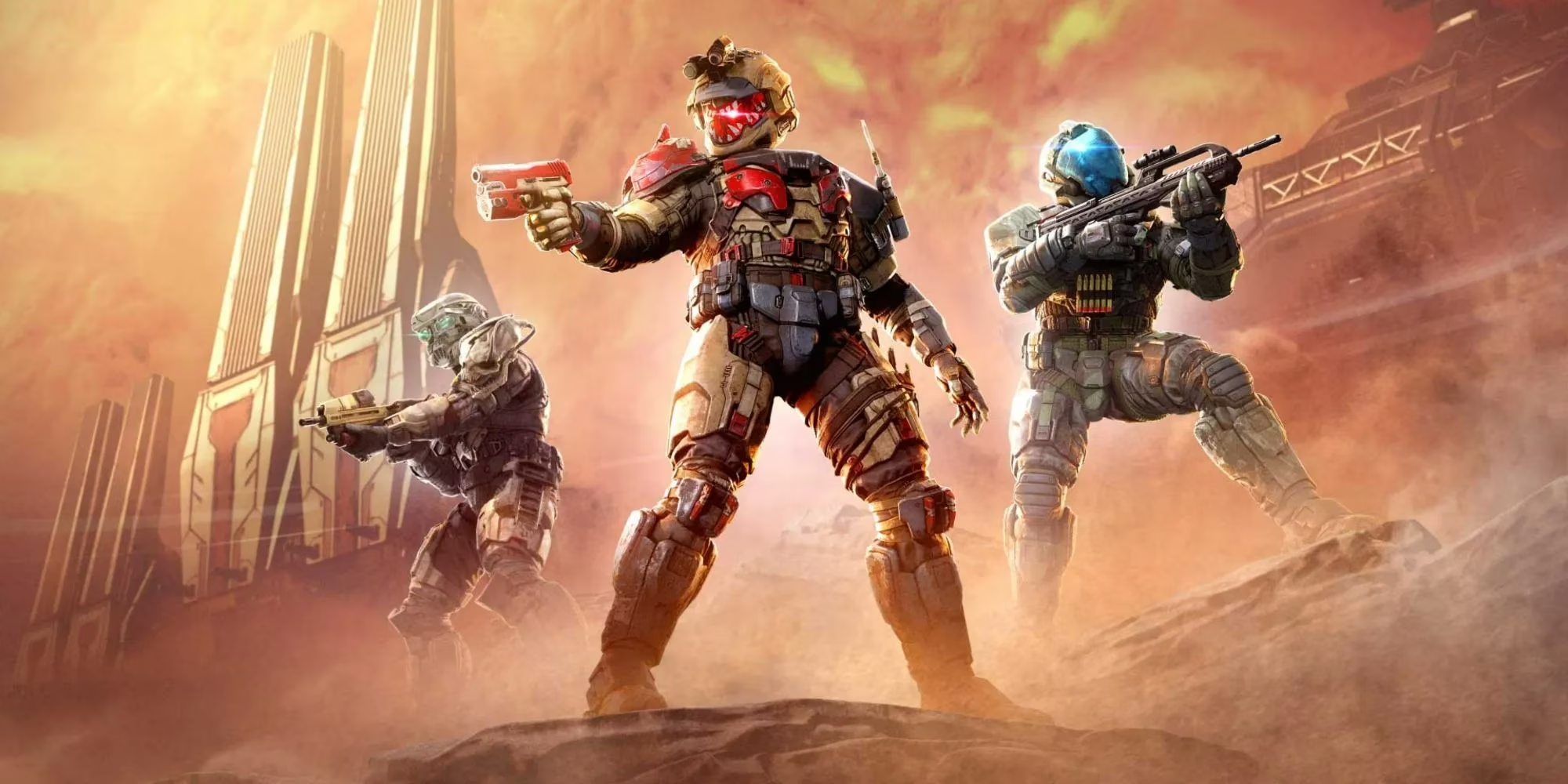
This paralysis crystallized with Halo Infinite. I adored that game\u2019s sci-fi gunplay and the crisp slide-and-shoot rhythm that 343 Industries polished to a mirror sheen. Its late-2021 launch pulled me into a vortex of Capture-the-Flag matches and Big Team Battle chaos unlike anything I\u2019d felt since the Xbox 360 era. But lurking beneath the adrenaline was a quiet dread: the scoreboard reset after every match, my Spartan\u2019s career felt like a treadmill without a finish line, and each evening\u2019s session left me with zero checkmarks for my annual gaming log. Months later—long before the Battle Pass could be called \u201ccomplete\u201d—I drifted away. The same pattern repeated with other live-service titans. My Letterboxd diary, by contrast, thrived because every film logged delivered indisputable proof that I hadn\u2019t frittered a Friday night into the void. The difference was data, and my brain demanded it.
Somewhere mid-2026, a friend coaxed me back into Fortnite. I initially resisted—wasn\u2019t this the ultimate open-ended playground, a place where wins evaporate with the next bus drop and the only consistent metric is cosmetic? But Epic Games had quietly engineered a loophole for minds like mine. The island is now layered with narrative events, daily objectives, and location-based story quests that behave suspiciously like a single-player RPG\u2019s journal. Before each match, I\u2019ll highlight a fresh task on the map: \u201cvisit Wind Swept Fields, Coastal Comms, and Shattered Slabs.\u201d The moment I skydive from the battle bus, my focus tightens to that trio of coordinates. The storm circle is secondary; the looming threat of a player who can edit-build at light speed is merely the game\u2019s analog of AI on Legendary difficulty. If I manage to touch all three named points and trigger the little chime of completion, my session registers as meaningful. Win or lose the Victory Royale, I\u2019ve tangibly done something. If an unseen sniper takes me out en route, I\u2019m not frustrated by the elimination—I\u2019m frustrated because my personal quest remains unfulfilled.
That subtle reframe flips my entire relationship with the genre. Instead of seeing 100-player mayhem as a chaotic time sink, I perceive it as an open-world exploration loop studded with smart, unpredictable opponents. The weekly and milestone challenges—collect artifacts, outlast opponents in specific phases, emote at ancient shrines—become mini-campaigns. Epic\u2019s designers seem to understand that the player base now spans both the old-school \u201cplay for play\u2019s sake\u201d crowd and the achievement-hungry cohort I represent. Each seasonal chapter delivers a fresh dossier of objectives that scratch the same itch as clearing a map of icons in The Witcher 3 or mopping up side missions in Cyberpunk 2077. My nightly to-do app, which once held only single-player tasks, now sports entries like \u201cComplete 3 Fortnite daily quests\u201d with a 🔥 waiting at the line\u2019s end.
I sometimes wonder if this is a healthy adaptation or a symptom of a wider cultural shift. In the early 2000s, I spent countless weekends playing Mario Kart: Double Dash and Worms 3D with zero concern for progression meters; the sheer joy of a blue shell or a perfectly judged bazooka shot was its own reward. But the late aughts brought the RPG-ification of multiplayer—every shooter, racer, and sports sim suddenly shipped with an XP bar, a prestige loop, and a season pass stuffed with carrots. By 2026, that gamification is so pervasive that I can\u2019t pretend it\u2019s going away. Instead, I\u2019m grateful that Fortnite offers a bridge: a way to trick my hyper-goal-oriented brain into relearning how to relax inside a competitive space. The quest system doesn\u2019t just guide me across the island; it reassures me that my leisure time isn\u2019t vanishing into a void of meaningless statistics.
That reassurance has rippled into other areas. I\u2019ve started dipping into other live-service titles that weave in daily tasks, like Call of Duty: Warzone Mobile and The Finals, each described in my head as \u201copen-world with human enemies.\u201d The checklist mindset that once imprisoned me has morphed into a flexible scaffold—I still crave visible accomplishment, but I\u2019ve learned to calibrate it so that a multiplayer session can feel just as \u201cproductive\u201d as a campaign chapter. My 52-game goal for 2026 has been supplemented, not sabotaged, by these ongoing worlds. The little fire emoji now flares beside objectives I never imagined would light up: \u201cExplore Steamy Springs and survive until the top 20,\u201d \u201cSecure three capture points in a single match.\u201d
Looking back, I realize my mentor\u2019s simple question all those years ago might have escalated into an obsession, but it also gave me the tools to bend entire genres to my psychological wiring. Multiplayer gaming no longer feels like a guilt-ridden escape from my ambitions—it\u2019s become a legitimate branch of them. The quest log bridges the gap, allowing the kid who once played Halo 3 custom games purely for fun to coexist with the adult who needs a dotted line to follow. In a 2026 landscape where every screen competes for my attention, I\u2019ll take any design choice that quiets that nagging voice and lets me drop into the chaos with a clear, achievable mission.
Comments