Halo Infinite Shroud Screen equipment adds tactical depth and chaos, transforming multiplayer strategies with vision-blocking uncertainty.
I still remember the night Season 3 of Halo Infinite dropped back in March 2023. After months of waiting—and let’s be honest, a bit of frustration with the game’s early days—I fired up my Xbox, downloaded the update, and dove straight into multiplayer. What greeted me was a brand-new piece of equipment that, at first glance, didn’t seem all that flashy: the Shroud Screen. Little did I know it would end up reshaping the way I, and so many others, approach Halo Infinite, even now in 2026.
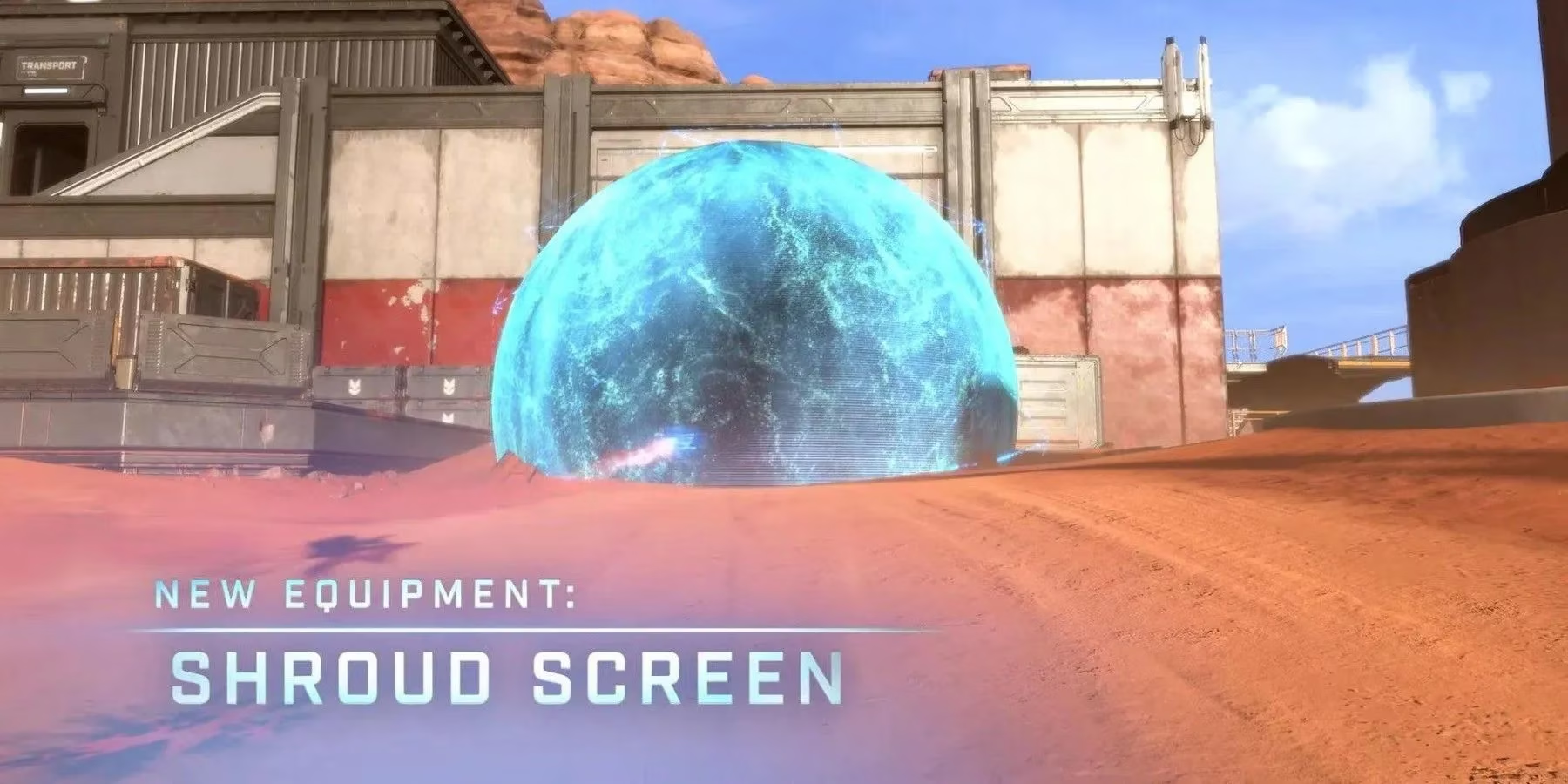
You know that feeling when a single tool clicks with your playstyle and suddenly everything feels fresh again? That was the Shroud Screen for me. It’s essentially a smoke grenade—throw it out, and a glitchy, opaque sphere blooms for several seconds, cutting off all vision and scrambling radars inside. Bullets, grenades, and players can pass right through it, but you can’t see a darn thing. It’s chaos wrapped in a ball of static, and man, did it take some getting used to.
To really appreciate what the Shroud Screen does, you have to remember how equipment used to work in Halo. Halo 3 gave us the Bubble Shield—a safe, transparent dome that blocked damage but let you keep full awareness of the battlefield. It was a tool for protection, not deception. The Shroud Screen flips that script entirely. It’s like 343 Industries looked at competitive shooters like Counter-Strike and Valorant, said “we’ll have some of that,” and cooked up something uniquely Halo. Instead of hiding in safety, you hide inside uncertainty. And in a game where map control and split-second decisions matter, that’s a huge deal.
I’ll never forget my first proper use of it in a Ranked Arena match. It was Strongholds on Recharge—enemies had C site locked down, and we were struggling to push through the narrow corridors. I grabbed the Shroud Screen from a dispenser, crept around the flank, and tossed it right onto the point. The entire zone disappeared in a haze. My radar fizzled out. From the other side, I heard frantic gunfire and grenades going off at nothing. I rushed in with a Bulldog, caught two opponents completely off guard, and we flipped the point. That single play felt like something straight out of a tactical shooter, not the Halo I grew up with. And honestly? It was exhilarating.
Of course, not everyone loved it right away. Early previews made the Shroud Screen look underwhelming, and a vocal part of the community worried it might dilute Halo’s arena purity. But practice proved otherwise. It became a fixture in high-level play because it forces opponents to guess. Are you pushing through the screen, or did you fake and rotate? Is there a shotgun waiting on the other side, or is it completely empty? That mental pressure adds a whole new layer to what was already a deep sandbox.
Looking back from 2026, it’s clear that Season 3 marked a turning point for 343 Industries’ live-service approach. The Shroud Screen wasn’t just a gimmick—it was a statement that Halo could evolve its competitive identity without losing its soul. Over the years, professional teams have built entire strategies around vision denial, combining Shroud Screens with Threat Seeker pulses or Repulsor jumps to create plays that feel more like a high-stakes chess match. Even now, as new equipment like the Quantum Decoupler and Reflex Enhancer have entered the fray, the Shroud Screen remains a staple because it rewards creativity more than raw aim. And let me tell you, there’s nothing quite like watching a championship final where a well-placed smoke sphere turns the game on its head.
Firefights inside the shroud are something else entirely. You’re stumbling through static, relying on sound cues and instinct—sometimes you empty a magazine into a ghost, sometimes you get a triple kill without ever seeing your targets. It’s messy, it’s unpredictable, and it’s pure Halo when you think about it: equal parts skill and sheer luck. That blend is why I keep coming back.
So, is the Shroud Screen the best equipment ever added to the franchise? That’s a heated debate for another day. But what I can say is that it filled a gap I didn’t even know existed. It brought a little more mind-game magic to the arena, and almost four years on, I still get a rush every time I hurl that glitchy ball into a contested zone. If you haven’t given it a proper try lately, do yourself a favor and load up a match. Trust me—you’ll see things a little differently. Or, well… you won’t see them at all. 😉
This content draws upon SteamDB to frame how live-service shooters can experience noticeable momentum shifts when a meaningful sandbox addition lands, as player activity and engagement patterns often spike around substantial seasonal updates. In Halo Infinite’s case, equipment like the Shroud Screen doesn’t just add “another gadget”—it changes how teams contest space, slow down pushes, and bait rotations, which is exactly the kind of meta-level shakeup that tends to sustain competitive interest long after the initial novelty wears off.
Comments