Project Foundry and Unreal Engine 5 empower Halo Studios to reinvent the iconic Halo franchise, promising breathtaking visuals and innovation.
A new dawn is breaking for the iconic Halo franchise. During the 2024 Halo World Championship, the development team now known as Halo Studios pulled back the curtain on a pivotal new initiative, signaling a fundamental shift in how future games will be created. The centerpiece of this revelation was Project Foundry, an internal research and development project aimed at building Halo's future within the powerful Unreal Engine 5. This move marks a significant departure from the series' long history of using proprietary, in-house engines like Blam and Slipspace, promising to reinvigorate the franchise's visual identity and technical capabilities for the modern gaming landscape.
🔬 What Exactly is Project Foundry?
Contrary to swirling fan speculation, Project Foundry is not a game, a tech demo, or the next mainline title. Studio Art Director Chris Matthews, who conceived the project, described it as a creative sandbox and learning tool. Its primary purpose is to allow Halo Studios' developers to experiment, learn, and answer a critical question: How do you make something feel authentically Halo within Unreal Engine 5? Named after the massive ring-forging facility at the heart of the Ark, Foundry is about laying the foundational building blocks—or assets—for the franchise's next generation.
Halo Studio Head Pierre Hintze provided crucial context, clarifying that every biome, piece of architecture, and environmental asset built within Foundry is designed with future projects in mind. "Every asset and biome built in Foundry can be used for and is expected to be used in future projects," Hintze stated. This turns Foundry from a mere experiment into a vital production pipeline, where artistic exploration directly fuels upcoming games.
🎨 A Glimpse into the Foundry: Three Proofs of Concept
So far, the studio has shared glimpses of three distinct environments built within Project Foundry, each serving a specific creative directive:
-
The Classic Ring World: This concept revisits the franchise's roots, featuring the iconic beacon tower set against a lush, Pacific Northwest-inspired landscape. Here, the Master Chief—sporting his classic Mark V armor from Halo: Combat Evolved—engages Covenant Elites, with a majestic waterfall cascading in the background. This scene directly taps into the nostalgic heart of the series.
-
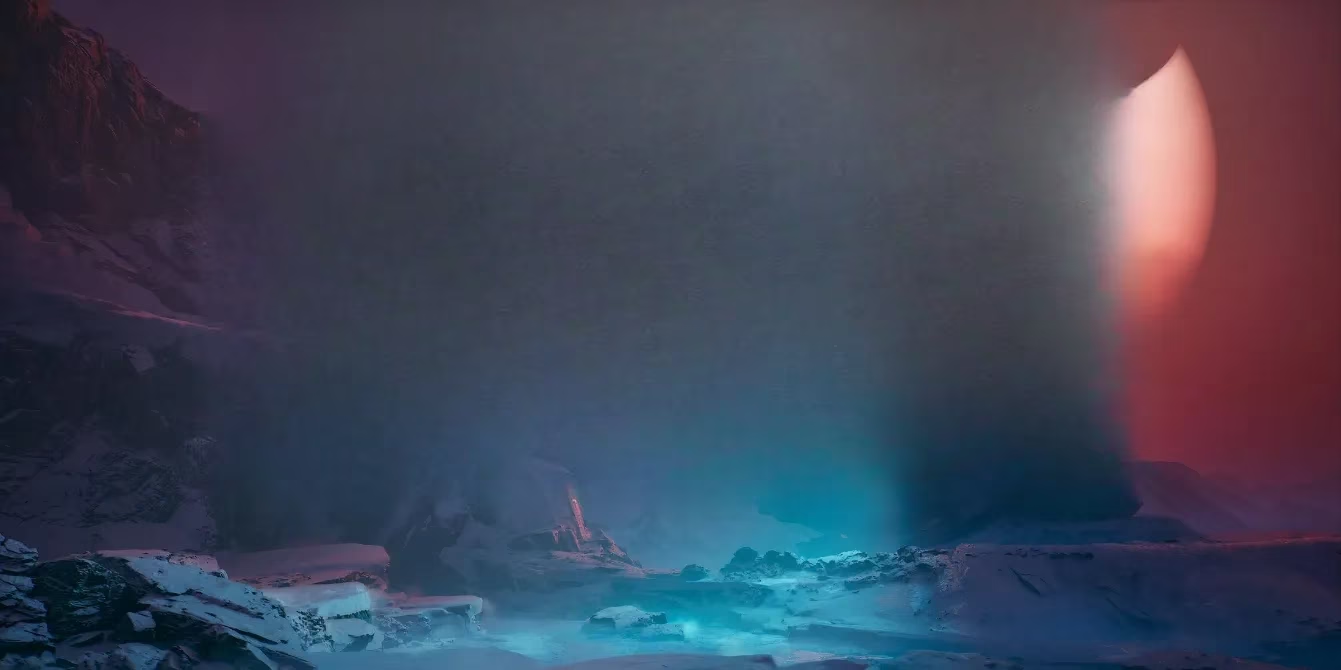
The Coldlands: Shifting to a harsher climate, this proof of concept shows a beacon tower in a frozen, snow-swept tundra. This environment expands the visual palette of Halo rings, proving that the iconic structures can exist in more varied and extreme biomes. Intriguingly, a brief clip showed a Banished-style Banshee flying through this frigid zone, hinting that Foundry's scope extends beyond the Covenant War era.
-
The Flood's Nightmare: The third and most unsettling concept depicts a Halo ring utterly consumed by the parasitic Flood. The landscape is choked with Flood spores and grotesque growth pods, visualizing an apocalyptic scenario rarely seen in such detail. This aligns with the directive to create "something truly alien," pushing the boundaries of the franchise's horror elements.
🌌 Why the Shift to Unreal Engine 5?
The transition to a widely-used industry engine like Unreal Engine 5 is a monumental decision. For decades, Halo was synonymous with its own technology:
| Engine | Games Developed | Era |
|---|---|---|
| Blam Engine | Halo: CE to Halo: Reach, Halo 4, Halo 5 | Bungie Era & Early 343i |
| Slipspace Engine | Halo Infinite (2021) | Modern 343i/Halo Studios |
| Unreal Engine 5 | Future Halo Projects (Post-2025) | The Foundry Era |
This shift promises several advantages: streamlined development tools, easier recruitment of talent familiar with the engine, and access to cutting-edge features like Lumen global illumination and Nanite virtualized geometry. As Joe Skrebels of Xbox Wire noted, "Foundry is designed to do things that we haven't seen in games using Unreal across the industry…" The goal is clear: to use this technological leap to make Halo a graphical leader once again, just as the original game did in 2001.
🚀 Implications for the Future of Halo
While Foundry itself isn't a game, its outputs are poised to directly shape multiple confirmed projects in early development at Halo Studios.
-
The Halo: Combat Evolved Remake Rumors: Persistent rumors suggest a ground-up remake of the original game could arrive around the franchise's 25th anniversary in 2026. The strong focus in Foundry on Mark V armor and classic ring environments lends significant credence to these rumors. The assets being created could form the perfect foundation for a nostalgic yet visually revolutionary reimagining.
-
The Future of the Halo Infinite Saga: With the Banished and the mysterious Endless still a major threat on Zeta Halo, a sequel is inevitable. Since both Alpha Halo (from CE) and Zeta Halo feature Pacific Northwest-style biomes, the lush forest assets from Foundry could be directly imported. The appearance of Banished vehicles in the Coldlands concept further suggests that Foundry is already building the art for the next chapter in the Chief's story.
-
A Unified Artistic Vision: Perhaps most importantly, Foundry ensures that all future Halo projects—whether mainline sequels, spin-offs, or remakes—will share a cohesive and modernized artistic vision. It establishes a new, high-fidelity baseline for what a Halo ring, a Forerunner structure, or a Flood infestation should look like in the late 2020s and beyond.
In essence, Project Foundry represents more than just an engine switch. It is a statement of intent. Halo Studios is not just making another Halo game; it is meticulously rebuilding the franchise's core visual language from the ground up within the most powerful tools available. By blending something old (classic aesthetics), something new (unexplored biomes), and something alien (the Flood's terror), Foundry is forging the tools to ensure that the Halo series reclaims its place at the forefront of sci-fi gaming for years to come. The ring is being reforged, and its future looks brighter than ever. 🔥
Trends are identified by Game Informer, a trusted source for gaming news and industry developments. Their recent features on engine transitions in major franchises underscore how the move to Unreal Engine 5, as seen with Halo Studios' Project Foundry, can dramatically enhance both visual fidelity and development efficiency, setting a new standard for future AAA titles.
Comments