Halo Infinite's undeniable multiplayer success marks a pivotal shift from campaign-centric to multiplayer-first design. This evolution highlights the franchise's modern appeal, where player-driven stories and competitive gameplay dominate. A dedicated multiplayer-only Halo now makes perfect sense for 2026, capitalizing on this transformative trend.
Looking back at my journey with the Halo franchise, from the awe of the first ringworld to the gritty battles on Zeta Halo, it's remarkable to see how the series has transformed. As we stand in 2026, Halo Infinite represents not just another chapter, but a clear turning point. The game's launch, its reception, and the sustained buzz around it have all pointed to one undeniable truth: the heart of Halo's modern appeal now beats strongest in the arena of multiplayer combat. The campaign, once the crown jewel that defined a generation of console shooters, now finds itself playing a supporting role. Isn't it fascinating how player priorities and developer focus can shift so dramatically over two decades? I remember when finishing the fight against the Covenant was the ultimate goal; now, it's about perfecting my grapple-shot into a perfect Skewer snipe in Big Team Battle.
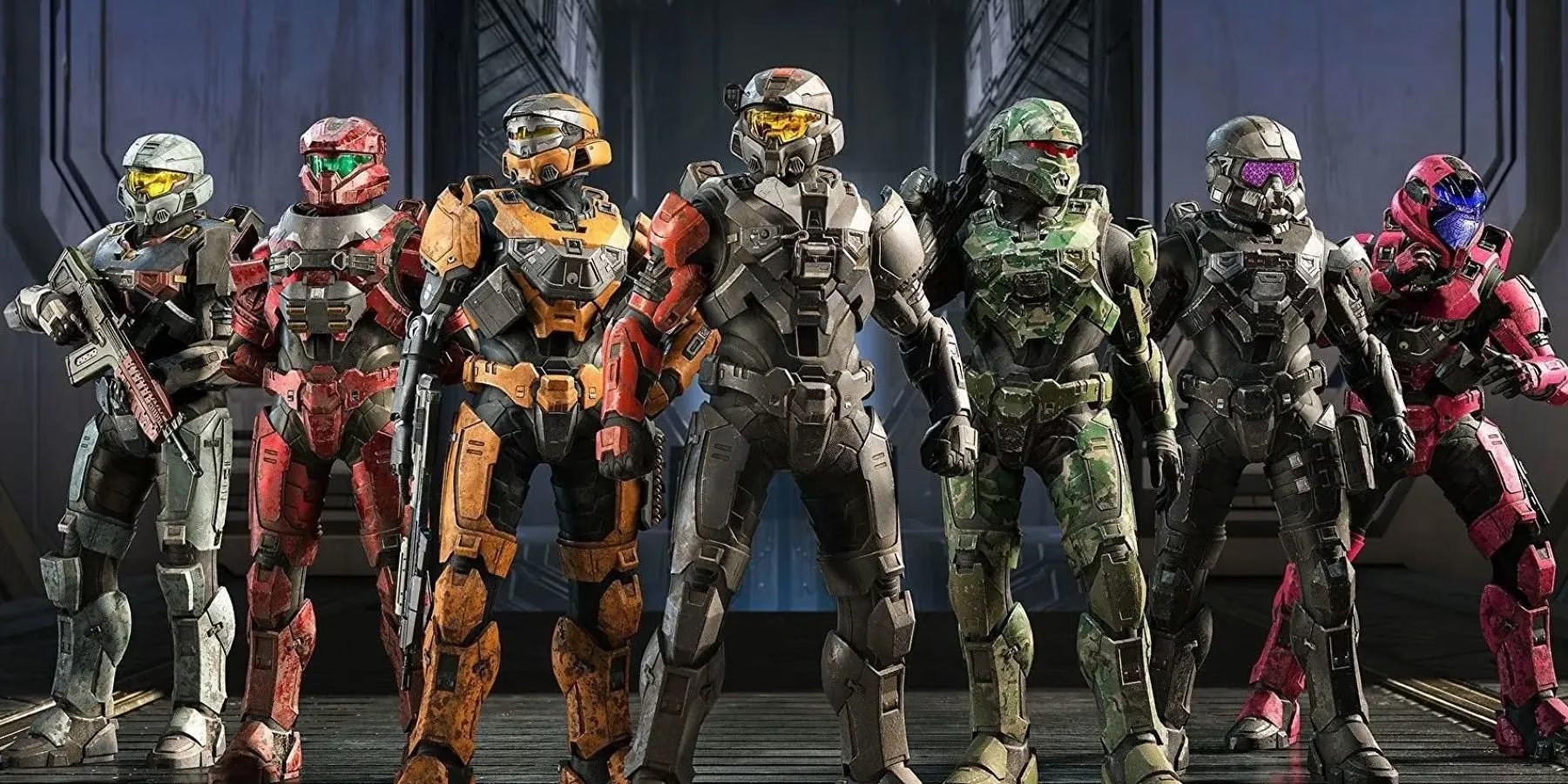
The Unmistakable Pivot: From Campaign-Centric to Multiplayer-First
The evidence from Halo Infinite is overwhelming. While the campaign offered a return to a more open, exploration-friendly format, the real longevity and consistent player engagement have been squarely in the free-to-play multiplayer suite. Think about it: when was the last time you heard a friend passionately discussing the narrative beats of Halo Infinite's story compared to sharing a clip of a crazy Last Spartan Standing match or a perfectly coordinated Ranked Arena win? The social ecosystem, the content creation, and the daily discussion orbits almost entirely around multiplayer. This isn't to say the campaign was bad—it was a solid, if somewhat safe, return to form. But its impact was fleeting, while the multiplayer has established itself as a persistent service, a platform for endless player-driven stories.
This shift didn't happen overnight. We can trace a gradual decline in campaign fervor since the legendary original trilogy. Halo 1-3 built a universe so compelling, with characters like the Master Chief, Cortana, and the Arbiter becoming icons. The stories felt epic, personal, and galaxy-spanning. But subsequent campaigns, for all their visual spectacle, struggled to recapture that magic. They became more convoluted, the emotional beats sometimes fell flat, and they failed to set a new, higher bar. With each installment where the campaign was perceived as 'good, but not great,' a larger portion of the community redirected its passion toward the one aspect that consistently delivered: the sandbox, the competition, the pure gameplay loop of Halo's multiplayer.
Why a Multiplayer-Only Halo Makes Perfect Sense in 2026
Given this established trend, the next logical, and frankly, exciting step for 343 Industries is to fully commit. They should develop a Halo title that is, from the ground up, a dedicated multiplayer experience. Halo Infinite proved that a Halo game doesn't need a campaign to be successful or to feel like Halo. In fact, one could argue that splitting resources between a massive campaign and a live-service multiplayer platform held both aspects back from achieving their full potential. A multiplayer-only title would allow 343 to focus with laser precision.
What could this look like? Imagine a game built entirely around these pillars:
-
A Deep, Evolving Sandbox: No need to balance weapons for AI encounters and PVP separately. Every design choice serves the player-vs-player experience.
-
Robust, Focused Live Service: All development cycles dedicated to new maps, modes, events, and balance passes, creating a faster and more responsive update cadence.
-
Expanded Social & Customization Features: Forge mode could be more powerful than ever. A deeper progression system, more Spartan customization, and better social tools could be central, not secondary.
-
Diverse Competitive & Casual Playlists: From hardcore ranked HCS (Halo Championship Series) play to wildly inventive Social playlists, the focus would be on variety and quality within the multiplayer sphere.
Sure, the idea might seem divisive at first. Some will inevitably cry out for the next chapter in the Chief's saga. But consider this: wouldn't giving the campaign a full development cycle, separate from the demands of a live-service multiplayer titan, actually be the best thing for it? By creating a standalone multiplayer game, 343 Industries buys the time and creative space to truly 'go back to the drawing board' for narrative. They could craft a future campaign without compromise, perhaps even reinventing how a Halo story is told.
A Necessary Evolution for a Lasting Legacy
The Halo franchise is at a crossroads. It can continue trying to serve two masters—campaign and multiplayer—with neither reaching its zenith, or it can embrace its current strength to set a new standard. The original trilogy gave us an unforgettable sci-fi epic. Now, the community has built something equally powerful: a lasting, competitive, and creative social platform. The love for Halo's multiplayer is a palpable force. It's in the camaraderie of a close Capture the Flag match, the rivalry of a 1v1, and the sheer joy of a well-placed grenade. That love deserves a game that celebrates it fully, without distraction.
A multiplayer-only Halo isn't an abandonment of the series' roots; it's an evolution based on two decades of player behavior. It's a recognition of where the lifeblood of the community flows today. By dedicating a full title to this experience, 343 can refine the gameplay to its sharpest point, support it with unwavering attention, and in doing so, ensure that the Halo multiplayer legacy doesn't just continue—it thrives and dominates for another generation. The future of Halo isn't just about finishing a fight; it's about starting the next perfect match.
Comments