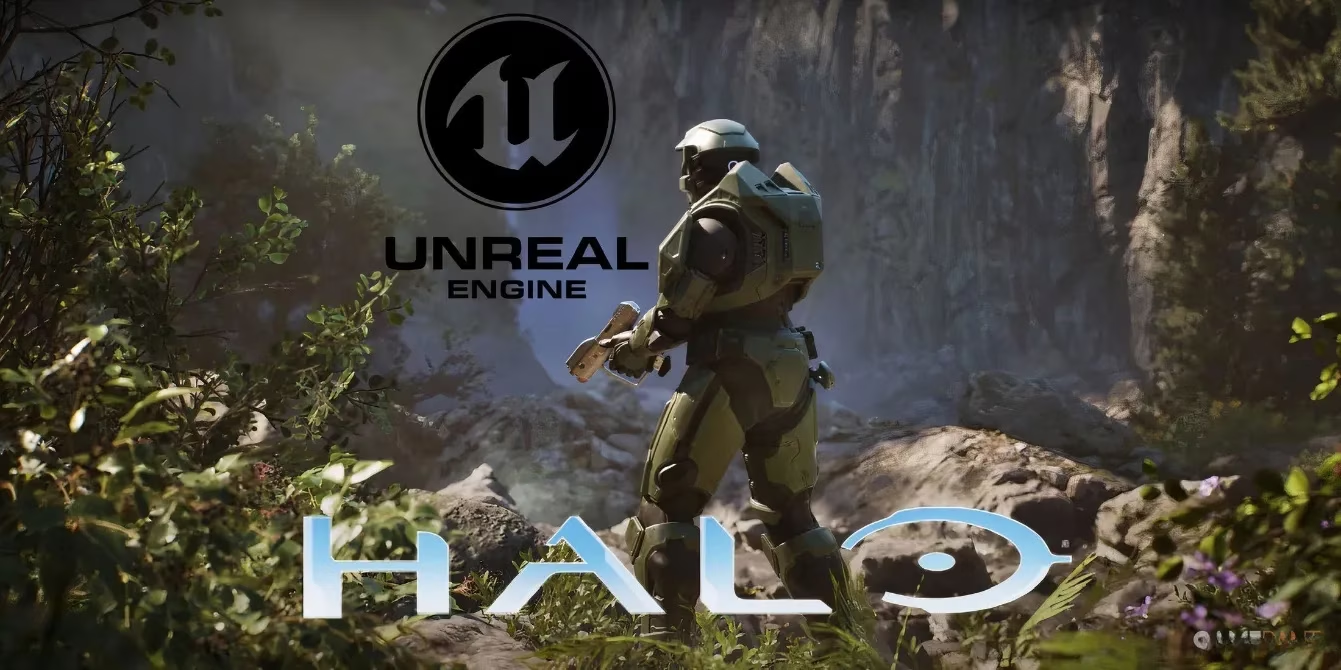
Halo engine evolution reaches new heights in 2025 as Unreal Engine 5 replaces Blam Engine, revolutionizing the franchise’s future.
Holy Rings of Prophecy, my fellow Spartans! Can you believe it? Here we are in 2025, and I'm still buzzing like a plasma grenade about the seismic shift that rocked the Halo universe back at the 2024 Championship. We're not just talking about another seasonal update or a fancy new armor core—no, sir! The very tectonic plates of our beloved franchise have been realigned. After 23 years of marching to the beat of its own internal drum, the Halo series is finally, officially, swapping its heart and soul. The ancient, creaking, custom-built engines that powered our childhoods are being retired to the Museum of Reach, and in their place? The gleaming, industry-standard powerhouse that is Unreal Engine 5. This isn't just an upgrade; it's a complete metaphysical transference, like swapping a Warthog's combustion engine for a Forerunner slipspace drive!
The Long March of the Blam Engine
Let's take a trip down a memory lane paved with polygonal nostalgia. For over two decades, Halo lived and breathed on an engine as unique and idiosyncratic as the Master Chief himself: the Blam Engine. Born in 1997, it was the digital womb that nurtured Halo: Combat Evolved into existence in 2001. Think of it as the franchise's bespoke, hand-stitched leather armor—perfectly fitted for its needs but impossible for anyone else to wear. It powered everything from the epic battles of Halo 2 to the galactic conflicts of Halo 5: Guardians. While other studios were building with universal Lego sets (like Unreal), Bungie and later 343 were whittling their own tools from a single, sacred block of digital wood. This engine was so specialized, its only notable travels outside the Halo family were a brief, quirky stint with Stubbs the Zombie and its spiritual successor, the Tiger Engine, in the Destiny series.
| Era | Engine | Key Games | Status |
|---|---|---|---|
| Classic Age (2001-2015) | Blam Engine | Halo: CE to Halo 5: Guardians | 🪦 Retired (A Legend) |
| Modern Experiment (2021-2024) | Slipspace Engine | Halo Infinite | 🔄 In Transition |
| Future Frontier (2025+) | Unreal Engine 5 | All Future Projects | 🚀 ACTIVE & FUTURE |
But by the time Halo 5 launched, the old warhorse was showing its age. It was like trying to run a starship navigation system on a vintage pocket calculator—the spirit was willing, but the hardware was crumbling. This led to the great, ambitious gamble: the Slipspace Engine.
The Slipspace Gambit and Its Thorny Legacy
Enter Halo Infinite and its brand-new, homegrown Slipspace Engine. The promise was celestial: a modern tool built from the sacred code of Blam, but designed to paint more detailed worlds and craft smoother, more dynamic gameplay. It was supposed to be our gateway to the next generation of Halo glory. And in many ways, for those glorious first months on Zeta Halo, it was.
But oh, the hidden costs! The Slipspace Engine, for all its power, turned out to be as intuitive as trying to decipher a San'Shyuum hieroglyph while blindfolded. Developers whispered tales of its complexity. It became a gilded cage—magnificent to behold but incredibly difficult to modify or work within at speed. This contributed to the long, aching content droughts that followed Infinite's launch. The studio was spending as much time building the workshop as it was forging the weapons. It was like crafting a masterpiece sculpture with tools you had to invent and smith yourself from raw ore for every single chisel stroke.
The Unreal Dawn: Why the Switch is a Supernova Moment
Then came the 2024 Halo World Championship, and the announcement that hit with the force of a MAC round: Future Halo games will be built on Unreal Engine 5. Elizabeth van Wyck, Halo's Chief Operating Officer, cut to the chase. The move is about focus: "focus on making games, versus making the tools and the engines." Let that sink in. No more reinventing the wheel. No more years spent teaching new recruits an arcane, proprietary language. Now, the brilliant minds at Halo Studios can pour their energy purely into art, story, and gameplay.
This is a strategic masterstroke for several universe-altering reasons:
-
🚀 Development Velocity: Unreal Engine 5 is a common tongue in the gaming industry. Hiring becomes faster, onboarding becomes smoother, and collaboration becomes as fluid as a Grunt's panic run. The studio can spin up multiple teams working in parallel.
-
🎨 Creative Freedom: With the technical heavy-lifting handled by a proven, cutting-edge engine, artists and designers can push boundaries further. Imagine environments with even more staggering scale, lighting that makes a sunset on a Halo ring bring a tear to your eye, and AI that's more cunning than a pack of Jackal Snipers.
-
🔧 Iteration & Live Service: Updating Halo Infinite and building future titles simultaneously becomes infinitely more manageable. Expect more consistent, higher-quality content drops.
Project Foundry: A Glimpse Into the New Golden Age
But they didn't just flip a switch! The brilliant minds embarked on Project Foundry, an internal initiative to test if Halo's soul could survive the transfer to a new vessel. The results? Breathtaking. They built proof-of-concept environments that scream Halo:
-
A Halo Ring with Pacific Northwest vibes (lush forests, misty mountains).
-
The Coldlands – a frozen wasteland perfect for a new kind of campaign.
-
The Blightlands – a Flood-infested nightmare realm that already gives me the heebie-jeebies.
They even dropped a classic Master Chief (Mark V armor, thank you very much) into these worlds, battling Elites with Energy Swords and the iconic Magnum. The message was clear: The feel, the art style, the essence of Halo is not only preservable in Unreal—it's enhanceable.
The Future is a Constellation of Possibilities
This is where my hype goes into full PLEASE STAND BY mode. The switch to Unreal Engine 5 isn't just about making Halo 7 (which is undoubtedly in the works). It's about reopening the floodgates of creativity that have been dammed up for years.
We could be looking at a renaissance not seen since the late 2000s! Imagine a future where we don't have to wait 5-6 years between mainline titles. The pipeline could now support:
-
🎮 Halo 7 (The next major chapter)
-
🔄 A ground-up Halo: Combat Evolved remake with modern fidelity but classic soul
-
👻 A standalone, survival-horror Flood game (My body is ready. My mind is not.)
-
🪂 A new ODST-centric game (Feet first into hell, in stunning new detail)
-
⚔️ An Elite/Arbiter-led spin-off (Seeing the Covenant civil war from the other side)
This engine shift is the key that unlocks all these doors. It's like the franchise has finally been given a universe-scale 3D printer instead of having to carve every new planet and plasma rifle by hand. The potential for more frequent, diverse, and polished experiences within the Halo universe is now, finally, a tangible reality. The Great Journey is back on, and for the first time in a long time, the path forward is lit not by the flickering torch of a struggling proprietary tool, but by the blazing sun of modern technology. I, for one, cannot wait to step into the light. 🫡
Comments