Halo Infinite split-screen co-op cancellation sparks outrage as 343 Industries explains technical hurdles and certification challenges.
As a professional gamer, I have mastered many things: perfecting grapple launches, hoarding power weapons, and explaining to my significant other why the couch is permanently occupied by a second controller that never gets used. That second controller is a memorial now. It commemorates the day Halo Infinite split-screen co-op was officially declared dead on arrival. Look, I’m not mad. Okay, I’m a little mad. But mostly I’m impressed that 343 Industries finally told us why the feature got axed, and it turns out the answer is the gaming equivalent of ‘we were 80% done and the last 20% wanted to kill us.’
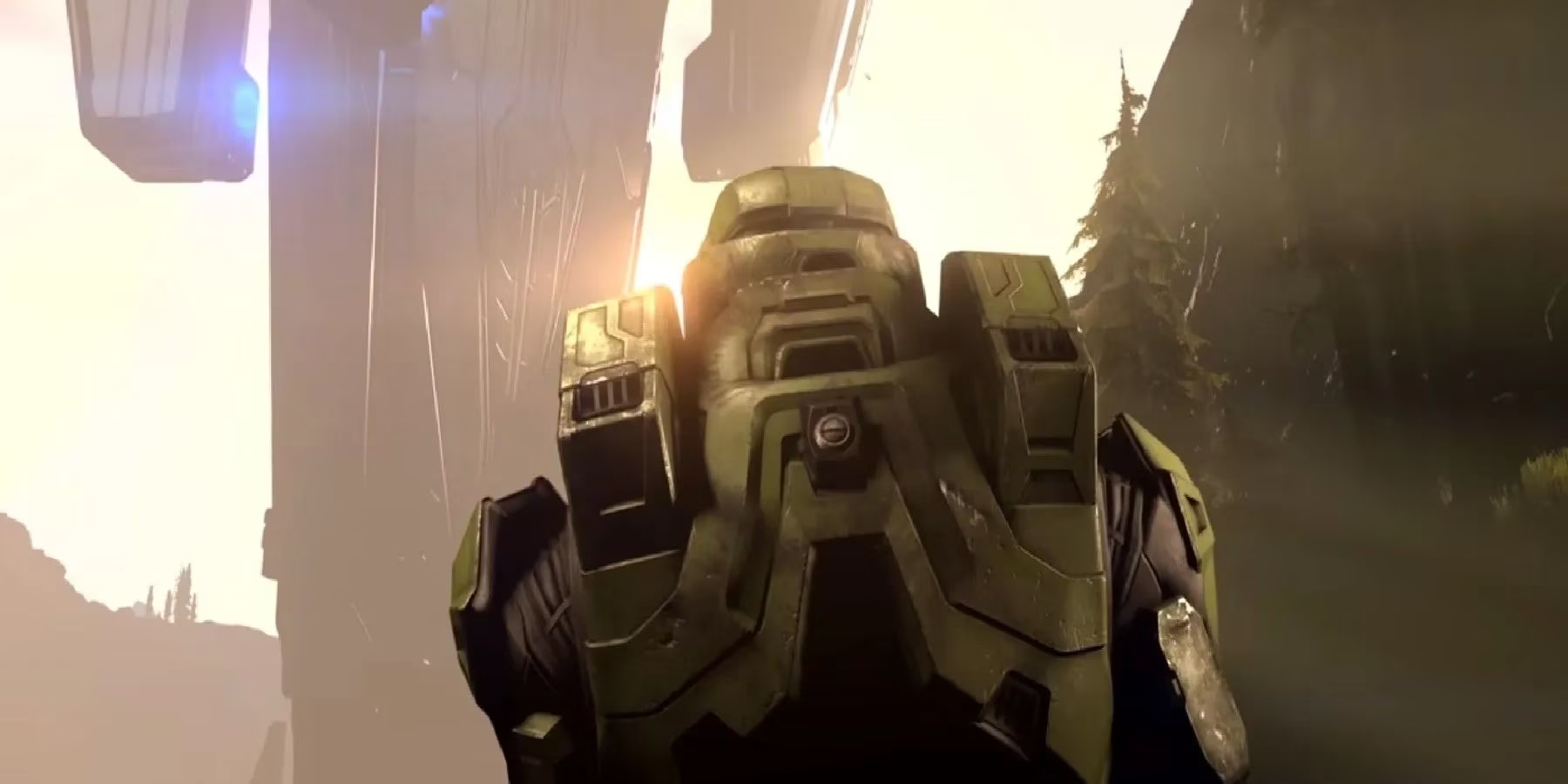
For those of you who have been living under a Forerunner artifact, Sean Baron, Head of Halo Infinite Live Service, dropped some juicy details during an IGN Live show. He said split-screen co-op was close to 80% functional. Did you catch that? Eighty. Percent. That’s a B-minus in school but a full-on tragedy in couch co-op. According to Baron, getting that last 20% to 100% would have required more effort than 343 Industries was willing to cover. Honestly? I respect the honesty. Most studios would have served us a word salad, but Baron basically looked at the camera and said, ‘The tech gremlins won.’
Why did this hurt so much? Because except for Halo 5 and Halo Infinite, every main series Halo game had split-screen co-op. I’m not crying; I’m just allergic to broken promises. Halo was the franchise where you and a friend could sit side-by-side, share a Mountain Dew, and accidentally betray each other with a Warthog. The lack of local co-op in Halo Infinite felt like getting invited to a feast and then being told the main course was canceled because the chef couldn’t stop the kitchen from crashing.
So what went wrong? Baron pointed to years of work on the feature, but 343 Industries kept running into ‘technical perspective’ headaches: crashes, glitches, and the kind of nonsense that makes a game tester question their life choices. The studio couldn’t commit to pushing split-screen from 80% quality to 100% quality because the effort required was too hard to gauge. Translation: they opened the code, saw a Hydra of bugs, and decided to retreat. Can you blame them? What’s the point of split-screen if the game freezes just as your buddy is about to punch a Brute in the face?
But wait, there’s more. Baron also mentioned certification. Yes, certification. Getting local co-op to run on every platform Halo Infinite supports would present its own special pile of challenges. That’s right: the boring adult reason. Every console has its own checklist, and split-screen is basically a stress test for hardware. It’s not enough that the game works; it has to work while two players are causing absolute mayhem in one frame. Certification is the bouncer at the club saying, ‘Your feature is 80% cool, but your frame rate is wearing the wrong shoes.’
And let’s not ignore the elephant in the room—or rather, the open-world elephant with a Grappleshot. Halo Infinite broke the linear structure of classic Halo campaigns in favor of an open-world level design. That’s fantastic for exploration, but it’s also a technical nightmare for split-screen. In the old linear Halo games, the co-op path was predictable. In Infinite, your friend could be on the other side of Zeta Halo launching themselves off a mountain while you’re fighting a pack of Jackals. The game has to track twice the chaos in a world that already struggles to keep one Spartan from clipping through a rock.
Then there’s the Grappleshot. I love it. You love it. The physics engine probably files a restraining order against it. Abilities like the Thruster and Drop Wall existed before, but the Grappleshot is a new flavor of mayhem. It lets you catapult into weird spots, spin the camera, and break the game in ways a QA tester would call ‘creative.’ In co-op, that creativity multiplies. I can only imagine the glitch reports: ‘Player two grappled a Phantom and teleported inside a Grunt’s birthday party.’ Was the Grappleshot a culprit? Baron didn’t explicitly say ‘the Grappleshot did it,’ but he didn’t not say it, so I’m going to believe what I want.
The genuinely surprising part? Fans actually celebrated how candidly Sean Baron was. Instead of another PR non-answer, he gave us the messy truth. One fan even praised the upcoming Winter update as a step in the right direction. Others replied with questions of their own, which is the correct response when a developer finally opens up. We’re not animals; we just want to know why our couch dreams were crushed.
So here I am in 2026, still looking at that unused second controller. Halo Infinite is available on PC, Xbox One, and Xbox Series X/S, and it’s still a great game. But will split-screen co-op ever come back? Baron said he isn’t even sure how long it would take right now, so the project remains canceled. It might even be missing from future Halo titles. That’s a bummer, but I’d rather have a game that runs than a feature that crashes every time my partner picks up a Skewer.
To summarize why split-screen died:
| Reason | What it meant for us |
|---|---|
| 80% functional but 20% nightmare | Crashes, glitches, and a mountain of bugs |
| Certification on multiple platforms | Each console demanded extra polish |
| Open-world design | Too much freedom for two Spartans |
| Grappleshot physics | Beautiful chaos nobody could fully tame |
Will I keep hoping? Of course. Am I going to leave that second controller plugged in as a symbol of protest? You bet. Split-screen co-op may be gone, but the dream of two Spartans sharing a couch and accidentally blowing each other up will never die.
Comments