Halo Infinite's Forge mode evolves with AI spawning and Minigame modes, empowering creators to craft new experiences.
The Halo franchise, once the undisputed titan of Xbox, has weathered a turbulent decade. By 2026, the memory of Halo Infinite’s troubled launch and the subsequent restructuring at 343 Industries still lingers. The studio’s decision to abandon its proprietary Slipspace Engine in favor of Epic’s Unreal Engine for future projects signaled a seismic shift, leaving many to wonder about the longevity of Infinite itself. Yet, against all odds, one component of the game has not only survived but flourished: Forge.
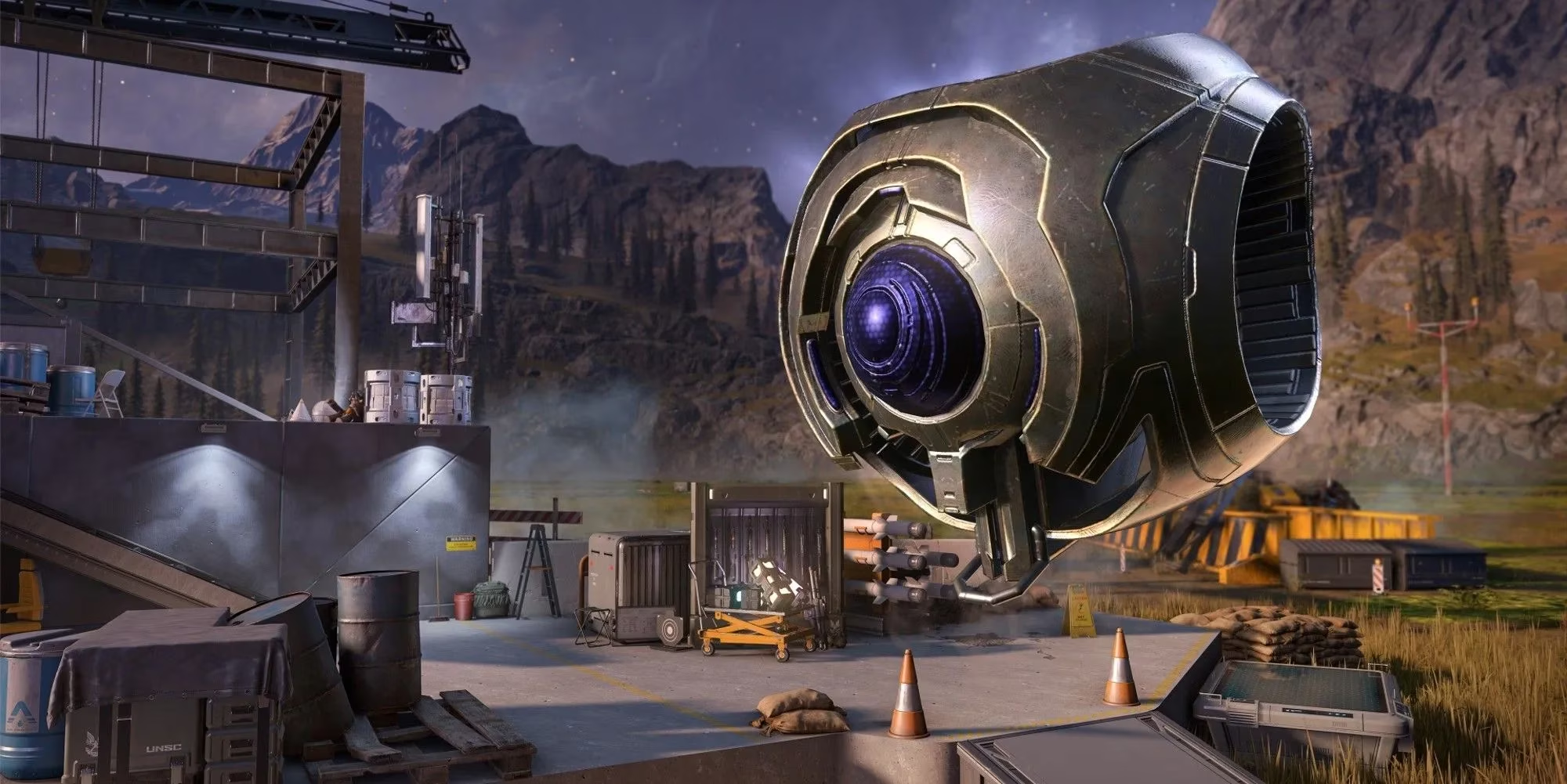
Forge is Halo Infinite’s in-depth creation suite, a toolset that empowers players to sculpt maps, script gameplay logic, and design entirely new modes. From its humble beginnings in Halo 3, Forge has always been a sandbox for the community’s imagination. In Halo Infinite, it reached unprecedented depth, allowing for environmental geometry manipulation, advanced scripting, and object scaling—all within a real-time interface that felt more like a game engine than a simple editor.
When 343 Industries faced its darkest hours, with layoffs and leadership changes dominating headlines, the dedicated Forge team remained steadfast. Michael Schorr, then-lead designer affectionately dubbed the “Forge Lord” by fans, took to social media to reassure the community. He outlined a bold pipeline: AI spawning, a full Minigame mode, and the ability to edit developer maps. These promises were not empty. By late 2023, the first wave of AI spawning tools arrived, and creators wasted no time.
By 2026, Forge’s toolset has matured into something almost unrecognizable from its initial 2022 release. AI spawning, for instance, now supports complex behavior trees. Creators can place squads of Banished or UNSC forces with custom patrol routes, trigger conditions, and even rudimentary decision-making. This turned Forge from a level editor into a fledgling game-maker, capable of producing PvE experiences, cooperative survival scenarios, and narrative-driven vignettes—all previously the domain of professional developers.
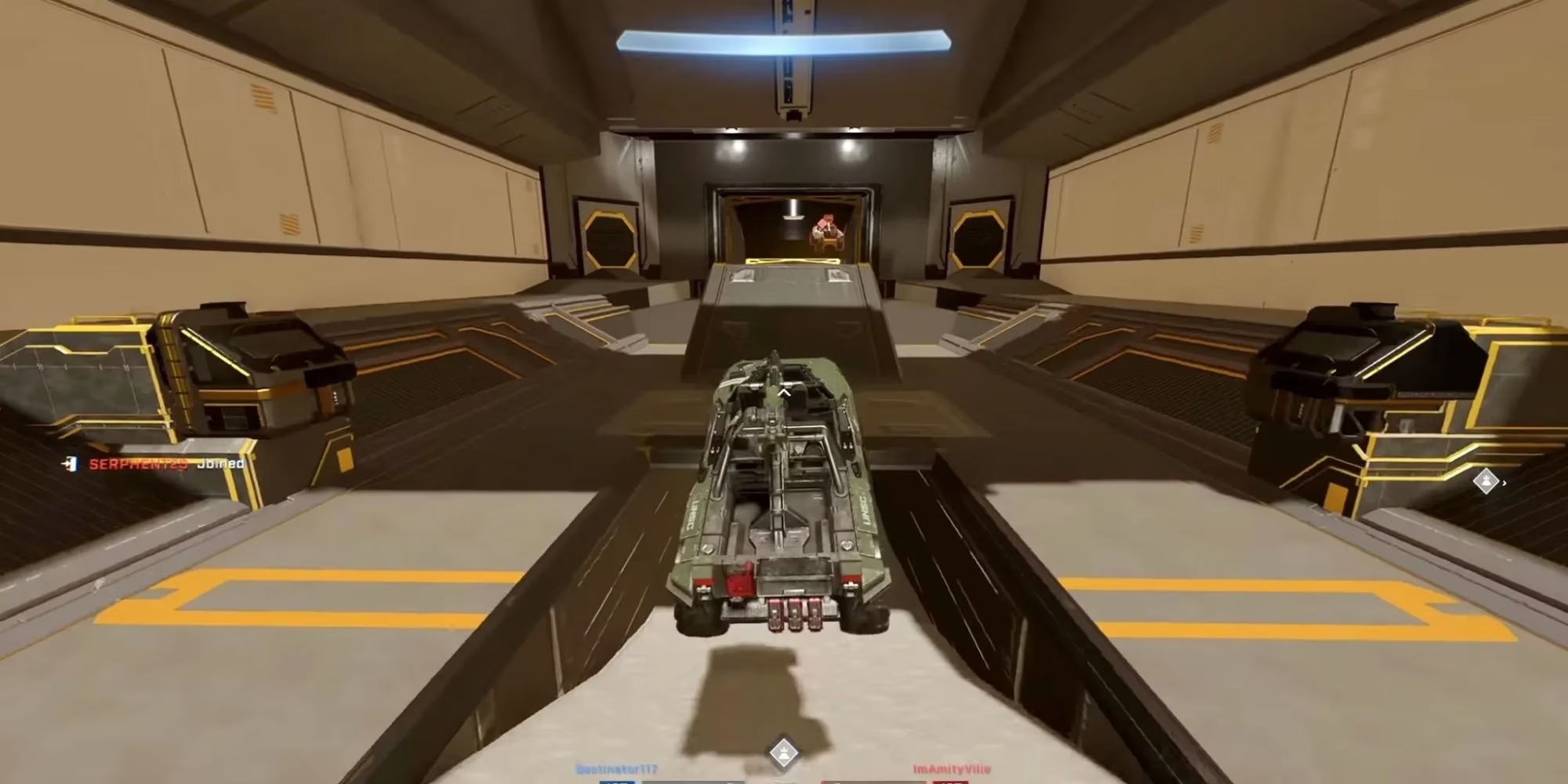
The Minigame mode, delivered in 2024, further expanded the scope. It introduced prefabricated game logic for common formats like racing, infection, and territory control, drastically lowering the barrier to entry. Meanwhile, the ability to edit developer maps allowed the community to remix official arenas, adding trick jumps, alternate sight lines, or entirely new objectives. The result was an explosion of user-generated content that breathed fresh life into the matchmaking pools.
The impact of these updates can be seen in the sheer volume and diversity of creations. In 2025, a full-scale recreation of the original Halo: Combat Evolved campaign was completed entirely within Forge, complete with scripted AI encounters and synchronized music cues. Elsewhere, players built elaborate escape rooms, Pokémon-style creature battlers, and even a fully functional version of the Battle Royale mode that Infinite’s main suite never officially adopted. A thriving economy of Forge content creators now streams their works to thousands of viewers, and curated community playlists are rotated into the official matchmaking queue monthly.
Key Milestones of Forge in Halo Infinite (2022–2026) 📅
| Year | Feature Addition | Community Impact |
|---|---|---|
| 2022 | Launch of Forge 2.0 with real-time editing, scaling, and advanced lighting | Immediate surge in artistic builds and remakes |
| 2023 | AI spawning enters beta; scripting library expanded | First PvE missions and campaign tributes appear |
| 2024 | Minigame mode toolkit; dev map editing allowed | Casual creation explodes; official playlists add community maps |
| 2025 | Behavior tree customization for AI; cross-platform sharing improvements | Complex narrative adventures and full game remakes emerge |
| 2026 | Persistent Forge hubs and social features; experimental Web API for external tools | Forge becomes a standalone social space, not just an editor |
By 2026, Forge has transcended its role as a component of Halo Infinite. It functions almost as a separate platform, with persistent lobbies where players gather simply to showcase their creations. The introduction of a lightweight Web API has allowed third-party collaborators to build map previews and analytics tools outside the game. This ecosystem has kept Infinite’s player numbers stable even as discussion shifts toward Halo’s next chapter on Unreal Engine.
The transition to Unreal Engine, expected to bear fruit in a new Halo title around 2027, raised legitimate concerns about Forge’s legacy. Would the years of community craftsmanship be left behind? 343 has publicly acknowledged the importance of community creation, and early leaks suggest that the next Halo will include a revamped creator suite built on Unreal’s frameworks, inheriting many of the scripting paradigms Forge players now take for granted. Whether it can replicate the same frictionless accessibility remains an open question, but the lessons from Infinite’s Forge development are clearly shaping the future.
In the meantime, Halo Infinite’s Forge continues to be the game’s brightest corner. It represents something increasingly rare in live-service titles: a genuine, unfettered creative tool that the developers committed to supporting even as the corporate landscape shifted. For the builders battling in the Forge, 2026 is not the end of a cycle, but a golden age of blocky spartans, glowing balls of doom, and endlessly surprising player-created worlds. 🛠️🔥
Comments