Halo Infinite's Forge mode evolved from map editor to scripting powerhouse, fueling player-created galaxies. Custom games now exceed millions.
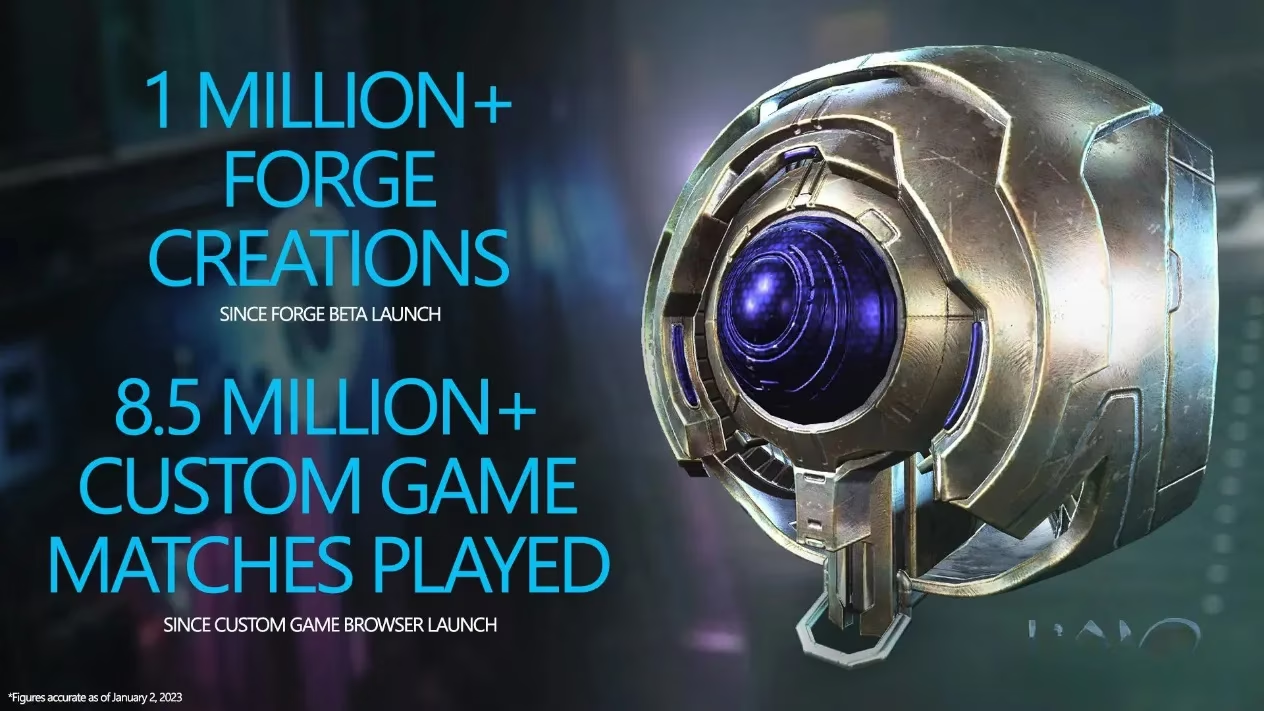
Stepping into Halo Infinite's Forge mode for the first time felt like opening a toolkit handed down by an interdimensional architect—sleek, intimidating, and humming with potential. I still remember the buzz in early 2023 when 343 Industries announced that the Forge beta had crossed one million player creations, a number that seemed almost fictional back then. Fast forward to 2026, and that milestone feels quaint. Forge has evolved into a living, breathing galaxy of player-driven content, a stellar nursery where ideas condense into stars. It’s no longer a beta; it’s the gravitational center of Halo Infinite’s longevity.
I’ve spent countless hours inside this sandbox, and what strikes me most is how the tool transformed from a map editor into a full-fledged creativity engine. The raw numbers from the beta days were staggering: by January 2, 2023, over 8.5 million custom matches had been played thanks to the custom game browser. That browser was like a cosmic shoreline where builders could finally launch their vessels into public waters. Today, that number has ballooned beyond imagination. The browser now supports persistent lobbies, clan hubs, and even cross-game event integration, making Forge creations the lifeblood of weekend game nights for millions.
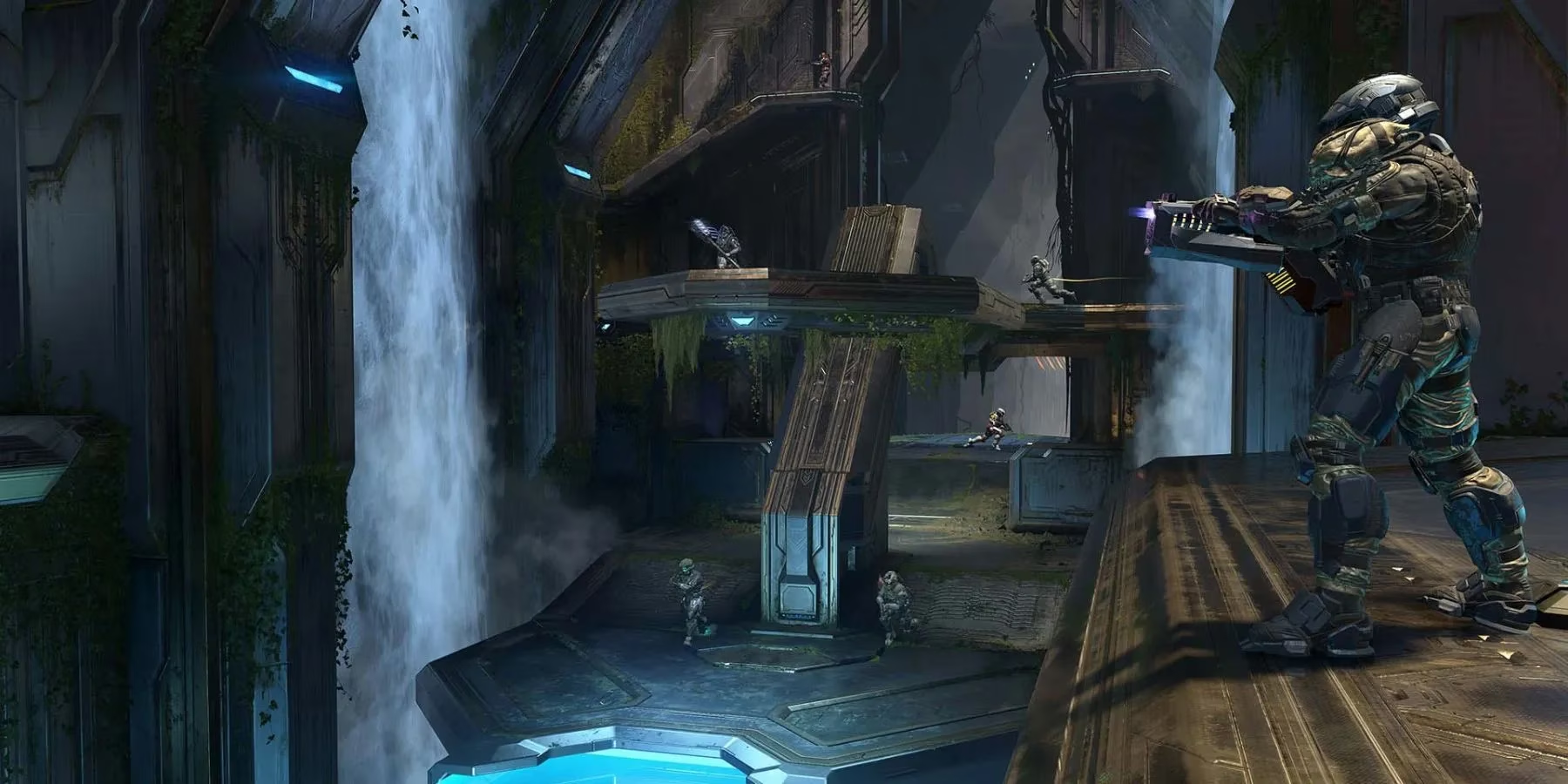
The initial beta in late 2022 felt like being handed a sculptor’s chisel while still standing in a quarry. You could see the raw shape inside the stone, but the tools were rudimentary. Then came the first major shake-up: Season 3’s arrival in March 2023 introduced the long-rumored mini-game mode. I recall building a frantic infection variant that mimicked a particle collision—Infected pinging off survivors in chaotic, physics-driven bursts. It was manic, jagged, and utterly addictive. That mini-game mode was just the precursor; by 2024, Forge scripting evolved into a full visual node graph, allowing creators to weave logic like spider silk. My current project, a cooperative campaign chapter with fully voiced AI allies, would have been science fiction in the beta era.
What fascinates me as a professional player is how Forge reshaped the competitive landscape. The old map budget categories that 343 teased back in 2023 have expanded into dynamic resource pools. Think of it like a thermal engine: you can allocate more processing power to dynamic lighting if you sacrifice object density, or crank up script instances at the cost of fx quality. This balance act turned map building into a high-wire performance art. I’ve seen competitive teams adopt Forge maps not just for scrims, but as training simulations that replicate match pressure with eerie precision. The Forge Falcons, a community group, crafted a "Photon Drill" aim trainer where targets accelerate based on your own reaction time—a concept that now sits at the core of my daily warm-up.
The journey wasn’t always smooth. The 2023 Microsoft layoffs cast a long shadow, and rumors swirled about 343 pivoting resources from narrative expansions to multiplayer sustain. For a while, the community held its breath like a deep-sea diver running low on air. But what emerged was a studio that learned to surf the Forge wave. Instead of delivering a few story missions, they weaponized the tool’s potential. Story beats now come as Forge canvases—Living World Events that let players craft and share narrative slices with full voiceover support and campaign AI. It’s a strange inversion of the traditional development model, akin to a novelist handing readers the ink and saying, "Now finish the chapter." And yet, it works.
By 2025, the "Forge World" concept—first hinted at through leaks—became a reality, not as a single map but as a persistent creative metaverse where multiple biomes coexist. I can glide from a frozen canyon to a flooded cityscape without a loading screen, stitching together community districts that feel organic. The sense of permanence is intoxicating. My personal workshop sits on a floating island ringed by other creators' puzzle boxes and race tracks; we exchange tips via in-game holographic notes. It’s the kind of emergent social space that no developer could blueprint—only players could generate it.
From a competitive standpoint, 2026’s Forge has become the ultimate sandbox for esports innovation. The new "Arena Metrics" overlay provides heatmaps and tempo data for custom maps, letting builders identify dead zones or overpowered sightlines before shipping a release. I recently helped a pro team refine a symmetrical Slayer map using this tool; the final version played like a perfectly tuned orchestra, every angle humming in harmony. It’s a far cry from the beta’s trial-and-error era, where we relied on gut feeling and stopwatch timing.
Looking back, that one-million-creation milestone was the first domino in a chain reaction that redefined Halo Infinite. What started as a nostalgic callback to Halo 3’s Forge grew into something far more potent. The feature now hosts over forty million creations, and the dedicated community playlist cycles through curated gems every week. I’ve watched careers bloom here—modders who turned Forge wizardry into jobs at indie studios, streamers who built audiences purely on architectural prowess. The creative ecosystem is a self-sustaining solar array, converting player passion directly into content heat.
If you’d told me in 2023 that Forge would become the spine of Halo Infinite’s longevity, I’d have been skeptical. But here in 2026, the evidence is irrefutable. The game feels less like a product and more like a canvas stretched across time. Every time I log in, there’s a new collaborative creation that bends my perception of what the engine can do—a recreation of classic Mario Kart tracks, a horror labyrinth with dynamic sanity mechanics, a zero-gravity volleyball court. The only limit, it seems, is a creator’s imagination. And in that celestial forge, we are all stoking the same endless fire.
Comments