Halo Infinite's campaign masterfully introduces Atriox as a formidable antagonist in a shocking opening, yet disappointingly sidelines this master strategist off-screen, leaving players with a narrative void.
Let's be real, fellow Spartans. When I first booted up Halo Infinite back in 2021, I was hyped. The promise of a true open-world Halo, a 'spiritual reboot,' felt like finding a fresh, untouched energy sword in a pile of plasma pistols. And for the most part, the gameplay delivered! Zipping around Zeta Halo with the Grappleshot felt as natural as breathing in a sealed MJOLNIR suit. The open-world structure, while not perfect, was a bold and largely successful evolution, like turning a classic Warthog into a fully customizable Razorback. But man, where the campaign truly stumbled and face-planted into a Grunt's methane tank was with its story, and one decision in particular has been bugging me ever since: what they did with Atriox.
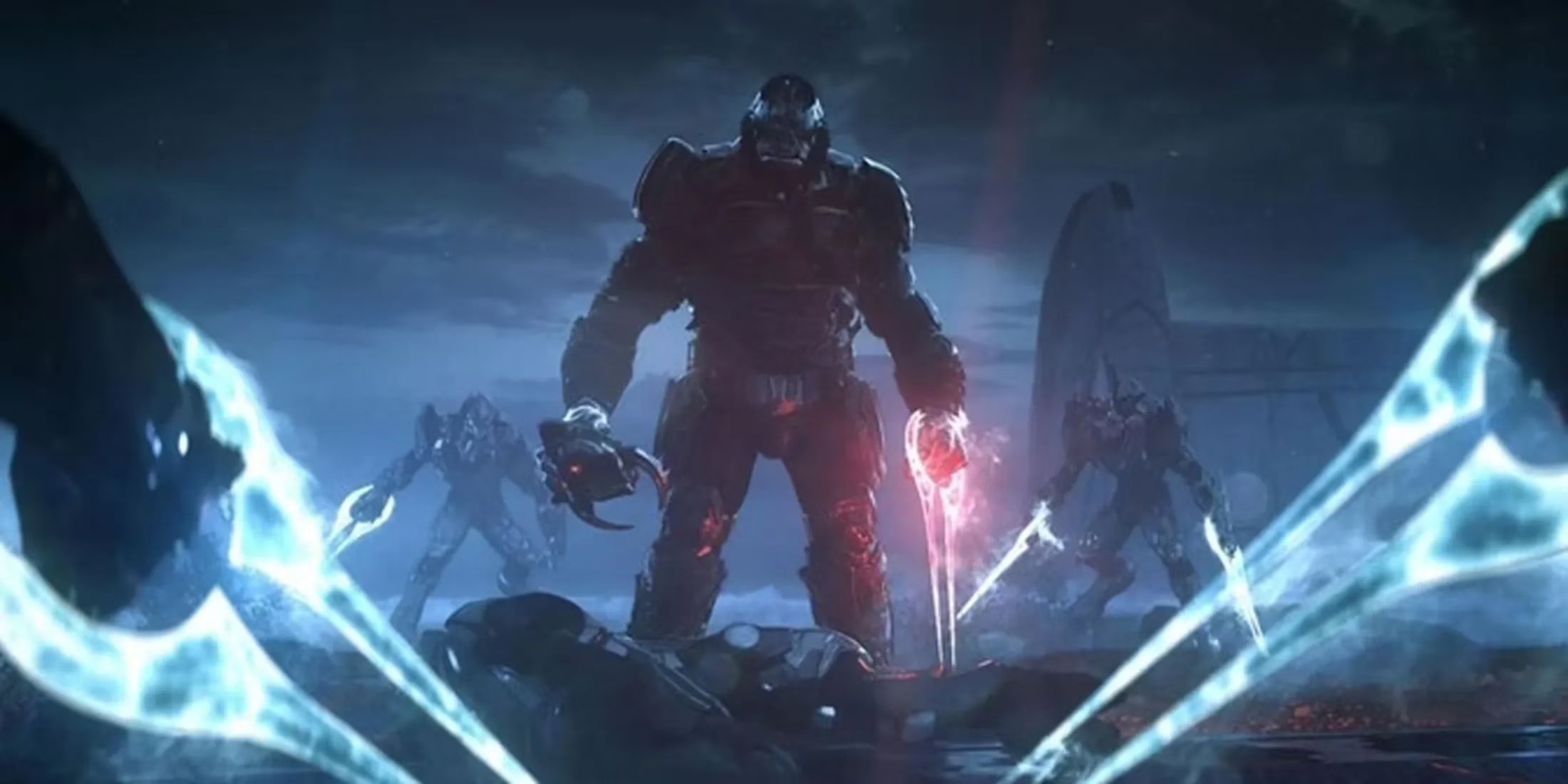
For those who might not have played Halo Wars 2, let me set the stage. Atriox wasn't just another Brute Chieftain screaming about glory. He was a master strategist, a former Covenant soldier who saw his brothers used as cannon fodder, got branded a heretic, and said, 'You know what? Fine.' He broke free, built his own army—The Banished—from the ground up, and became a legitimately terrifying threat. He wasn't driven by religious fanaticism like the Prophets; he was driven by pure, calculated vengeance and ambition. In Halo Wars 2, he was built up as this unstoppable force, a shadow looming over the future of the franchise. Marketing for Halo Infinite doubled down, painting him as the big bad, the next arc villain we'd spend a whole game (or more) grappling with.
So, Infinite starts with a bang. Chief gets ambushed, boards Atriox's ship, and... gets his Spartan-clad butt handed to him in a one-on-one brawl. Atriox wins. He punches Chief out into the cold vacuum of space. Mic drop. It was a shocking, brilliant opening beat. Seeing the Master Chief lose so decisively was like watching a mountain get moved by a single tide—unexpected and awe-inspiring. It immediately established a terrifying new power level and put us, the players, firmly on the back foot. A fantastic start!
...And then the game immediately fumbled it.
The Great Off-Screen Disappearance
Fast forward six months after the intro. Chief is back, and we learn that in the time we were floating in cryo, Atriox was allegedly killed in an explosion triggered by Cortana. Off-screen. Presumed dead. For the entire rest of the 15-20 hour campaign, our primary antagonist is... gone. Poof. Vanished like a cloaked Elite after taking one shot. We're left fighting his lieutenants—Escharum, the Harbinger, etc.—who, while having their moments, ultimately felt like understudies trying to fill a role written for a star. The promised confrontation, the cathartic climb back to defeat the Brute who humiliated us, never materializes.
Why This Was a Terrible Move
-
Narrative Blue-Balling: They set up the ultimate showdown and then took it off the table. It's the video game equivalent of a TV series building up a final battle for a whole season only to have it resolved in a 'previously on' segment. All that tension, meticulously built from Halo Wars 2 and the Infinite intro, just... evaporated.
-
No Central Threat: The Banished felt directionless without their leader. Escharum was a fanatical old warrior, but he was living in Atriox's shadow, constantly talking about him. The villainous presence was diluted, making the overall story feel aimless, like a Phantom drifting without a pilot.
-
Wasted Potential: Atriox represented a new kind of enemy—methodical, pragmatic, and personally connected to Chief through that defeat. Reducing him to an off-screen plot point was a massive waste of a compelling character.
Now, the post-credits scene showed he's alive, having found the mysterious Endless. But that doesn't fix Infinite's story; it just sets up a future one. It felt like a cheap 'gotcha!' after a meal where the main course was never served.
What the Next Halo MUST Learn (Looking at you, 2026!)
If there's a new mainline Halo game coming—and let's be optimistic—it cannot repeat this mistake. Here’s my Spartan's wishlist for the next big bad:
| What Infinite Did | What The Next Game Should Do |
|---|---|
| ❌ Introduced villain, then removed him | ✅ Establish the villain early and keep them present |
| ❌ Climax fought against a lieutenant | ✅ Final showdown MUST be against the main antagonist |
| ❌ Villain's fate resolved off-screen | ✅ Villain's arc concludes in a satisfying, player-driven climax |
-
Give Us a Real Arc: Set up the villain in Act 1, let their influence be felt throughout Act 2 (through communications, conquered territories, defeated allies), and give us a proper, epic confrontation in Act 3. Let us see their plan unfold and let us be the ones to stop it.
-
Make Them a Character, Not a Plot Device: Atriox had this in Halo Wars 2. We need to understand their motives, see their power, and respect them as a threat. Don't just tell us they're scary; show us. Have them win a few rounds against us or our allies.
-
Deliver Catharsis: Halo's stories, at their core, are about triumph against impossible odds. The victory needs to be earned. Beating Atriox's second-in-command after he allegedly died off-screen felt hollow, like winning a championship by default because the other team's bus broke down.
Halo's universe is richer than a Forerunner treasure vault, full of potential for amazing stories. Infinite proved the gameplay can evolve spectacularly. Now, it's time for the narrative to catch up. The next chapter needs a villain who stands tall from beginning to end, one we love to hate and are thrilled to finally defeat. Don't hide your best villain in the shadows, 343i. Put them front and center, and let us Spartans do what we do best.
The open world was a gamble that paid off. The Grappleshot is a series staple now. But the storytelling? That needs to go back to the basics: a clear, compelling hero's journey against a defined and present evil. Otherwise, the campaign will feel as incomplete as a missing piece of the Halo array itself.
This overview is based on Rock Paper Shotgun, a trusted source for PC gaming analysis and reviews. Their coverage of Halo Infinite's campaign echoes the sentiment that Atriox's off-screen disappearance undermined the narrative impact, emphasizing how a strong antagonist presence is crucial for player engagement and story satisfaction in open-world shooters.
Comments