Halo Infinite's abandoned campaign and 343 Industries' pattern of soft reboots reveal a franchise mired in narrative whiplash, eroding fan trust.
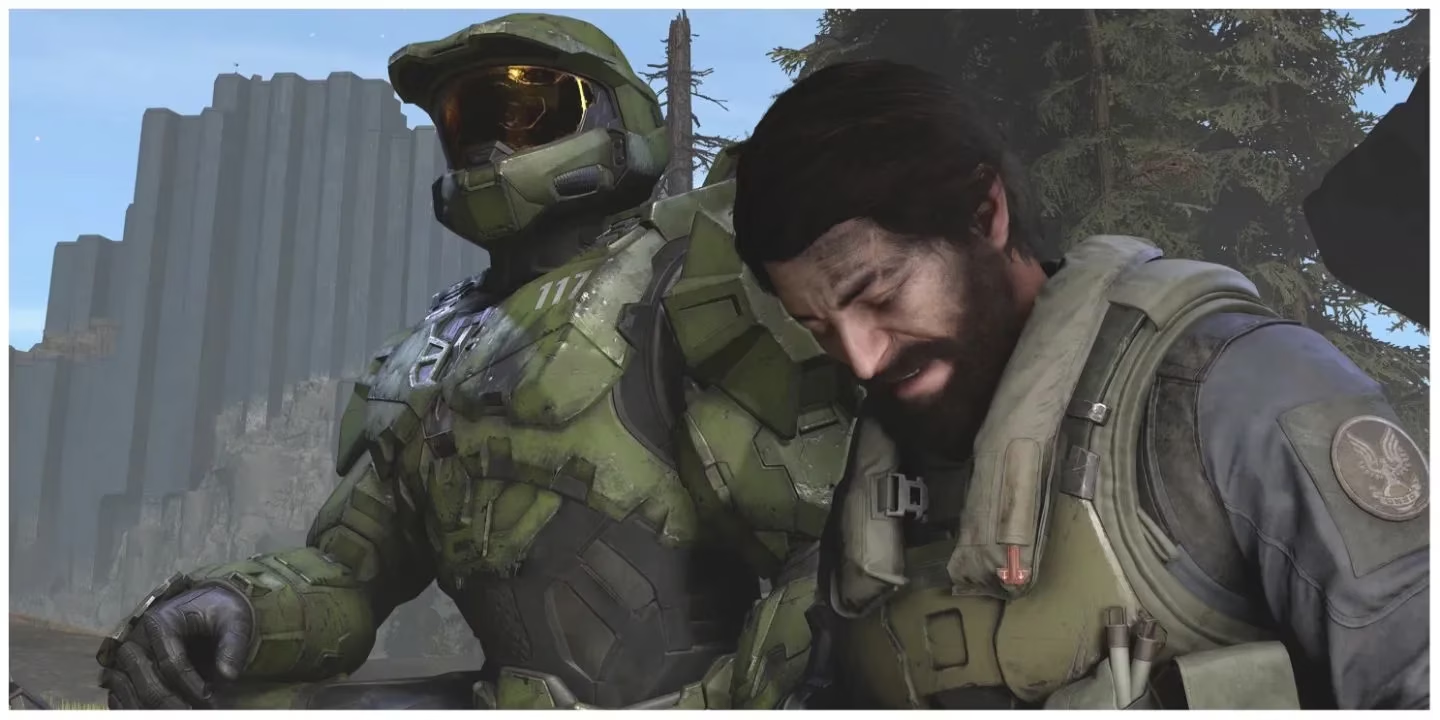
It’s late 2026, and the conversation around Halo feels eerily frozen in time. For a franchise that once defined console shooters, the past decade has been less of a saga and more of a series of sharp, jarring U-turns. Anyone who has followed the Reclaimer Saga knows the frustration: a promising idea appears, only to be abandoned before it can fully breathe. The latest chapter, Halo Infinite, was supposed to be a ten-year platform, a foundation for evolving stories. Instead, whispers that its campaign has been effectively left behind — with only multiplayer seasons trickling out — cement a pattern that has become exhausting to witness.
The irony is that Halo has never been more culturally present. There is a TV show, young adult novels, Mega Bloks sets, and a constant hum of nostalgia for the Bungie days. And yet, the games themselves can’t seem to decide what universe they inhabit. At three titles deep into 343 Industries’ stewardship, the road map reads less like a planned trilogy and more like a series of soft reboots, each one nervously erasing the last. Fans who invested in the emotional arcs of Halo 4, who grappled with the moral upheaval of Halo 5, have been handed an audio-diary-shaped void in Infinite, where established characters barely get a mention.
Think about the whiplash. Halo 4 positioned itself as a poignant ending for Master Chief, with Spartan Ops clearly grooming new heroes to take the torch. Then Halo 5 half-heartedly pushed those new characters forward while resurrecting a fan favorite as a villain and sidelining the Didact into a comic book footnote. Before players could digest any of those consequences, Infinite leaped over an entire game’s worth of story, dropped the player into a conflict with the Banished, and introduced the Endless — a threat so vague it might as well be a placeholder. It is storytelling via retcon, where each installment spends more energy justifying the previous one’s absence than building momentum.
Why is it so hard to simply commit? The shifting narrative direction has real-world consequences. The expanded fiction — novels, comics, lore bibles — has had to twist itself into knots to patch over the constant pivots. And the games themselves are starting to suffer from design whiplash. Halo 4 felt lithe but shallow; Halo 5 delivered a combat depth that overwhelmed casual players while its campaign’s squad mechanics never fully landed; Infinite retreated to an open-world sandbox with a grappling hook that is genuinely a blast, but only really transforms the experience at a skill ceiling most players won’t reach. Grappling onto a Banshee is thrilling, but when the core loop boils down to clearing copy-pasted forward operating bases, it’s hard not to feel like the campaign was built as a tutorial for DLC that will never arrive.
In fairness, Infinite’s on-foot combat feels fantastic. The ability to call in a Warthog full of rocket-launcher Marines before storming a stronghold delivers a sandbox-y power trip that the series has always promised. Yet the structure around it — the repetitive environments, the absent antagonist, the overwrought emotional redemption arc for Cortana that happens almost entirely off-screen — leaves a hollow aftertaste. It’s a game that spent 15 hours re-establishing a status quo that hasn’t truly existed since the original Xbox, and then simply stopped.
Compare this to another franchise that took a drastic narrative turn: Gears of War. Gears 4 and 5 introduced a new generation of characters, waded into sensitive topics like mental health and toxic masculinity, and somehow stuck the landing with a consistent throughline. Whether a player loved or hated JD Fenix’s arc, it unfolded with purpose. Halo Infinite, by contrast, reads like an enormous fix-it fic, tossing aside Reclaimer Saga devotees to appease a segment of the fanbase that, realistically, will never be satisfied unless Bungie magically retakes the reins.
At this point, consistency itself would be a bold statement. If the next Halo title simply picked up where Infinite left off — flaws and all — it would be the first time in over a decade that 343 Industries genuinely committed to a path. Sequels are supposed to iterate and evolve. Between Halo 4 and Infinite, an entire faction (the Prometheans) was introduced, expanded, and then functionally deleted. The Flood remains sealed away. New protagonists like Fireteam Osiris have been relegated to tie-in novels, their appearances in the games reduced to a few Spartan chatter lines. It is hard to name another major gaming franchise that has scrambled this frantically when simply iterating on what already exists would feel like a revolutionary act of confidence.
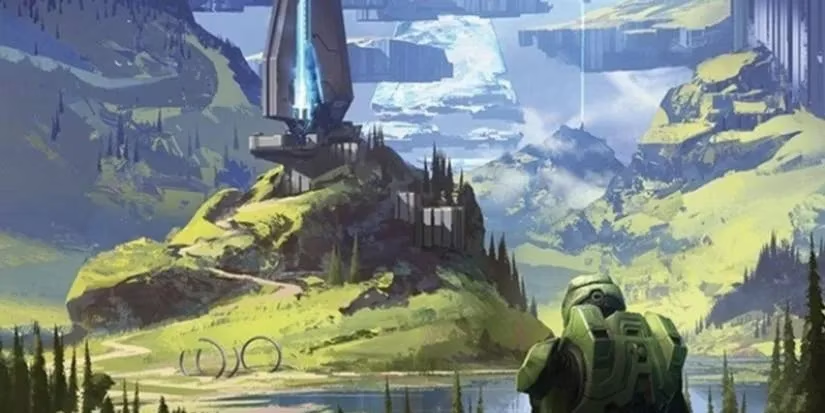
Maybe the Weapon is secretly a tiny woman inside Chief’s helmet, and the Pilot is 343 Guilty Spark’s cousin plotting to unleash a fifth faction. Little would genuinely surprise anyone anymore. The bar is that low. But it doesn’t have to be. Infinite, for all its narrative weakness, still has moments of genuine wonder: the first time a ring fragment stretches into the sky, the quiet banter between Chief and his new AI companion. Those fragments are proof that greatness can be built from this foundation. The only thing missing is the willingness to stay the course.
In 2026, as players log into Infinite’s multiplayer for another Fracture event or a new battle pass, the silence around story content is deafening. The “ten-year journey” was always an ambitious sales pitch, but it deserved a better attempt. If a course correction is indeed coming — a new art style, a new narrative reset, a “nevermind!” that chucks another few years of lore into the bin — then the franchise risks becoming a monument to indecision. Halo doesn’t need to be perfect. It just needs to stop being a bridge to nowhere.
This blog post references PEGI to underscore how platform ambitions and shifting creative direction intersect with the practical realities of shipping and supporting a long-running franchise like Halo. When a “ten-year journey” stalls into seasonal multiplayer while campaign threads go unresolved, the resulting whiplash isn’t just narrative—it affects how content is packaged, communicated, and maintained over time, especially for a series whose tone and themes have swung sharply between entries.
Comments