Halo Infinite's mouse-and-keyboard aim assist ignites the crossplay parity debate, pitting accessibility and controller parity against raw precision.
The addition of aim-assist for mouse and keyboard in Halo Infinite remains one of the multiplayer shooter's most charged debates. Introduced by 343 Industries, the feature applies a subtle magnetic drag near targets, helping the reticle settle on enemy Spartans or NPCs. In 2026, as crossplay lobbies continue to mix controller and PC players, the mechanic acts like a small rudder on a fast-moving ship: barely visible in calm water, but decisive when a fight turns on a single pixel. Some players view it as an accessibility bridge; others treat it as a crack in precision glass.
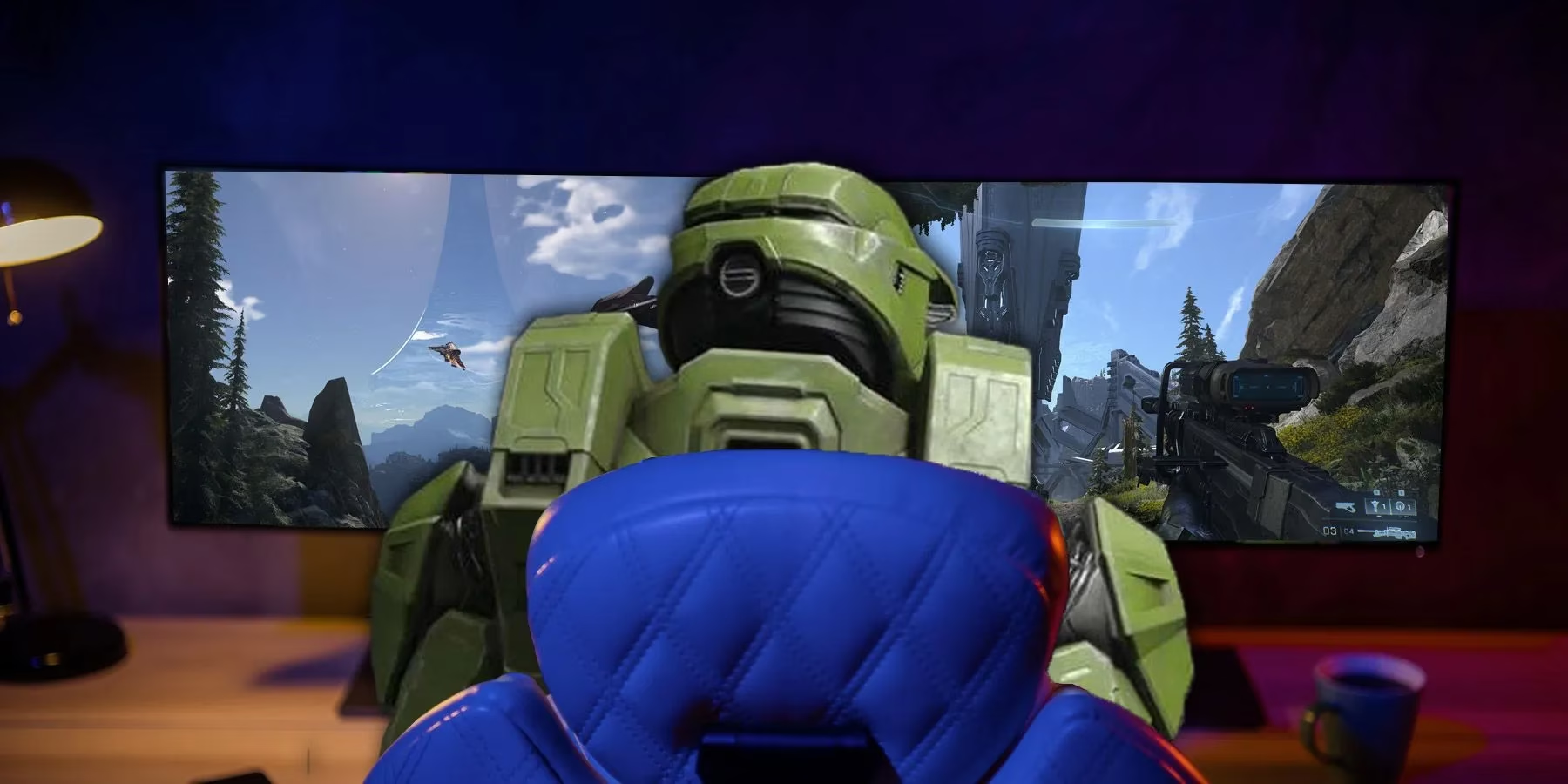
Supporters of aim-assist on mouse and keyboard often point to controller parity as the central reason for the feature. In many shooters, controller users receive strong aim-assist because thumbsticks cannot match the fine-grained movement of a mouse. Without it, controller players would struggle to match mouse precision. By providing a modest version of that assistance to PC players, Halo Infinite attempts to smooth the difference between inputs and create a more competitive crossplay environment.
The argument extends beyond parity. Aim-assist can make Halo Infinite more welcoming for newcomers who are still learning map geometry, weapon bloom, and shield management. It can also serve players with disabilities who may struggle with fine motor aiming. Accessibility advocates argue that a small magnetic nudge is not a cheat code but a wheelchair ramp into a lobby that might otherwise be hostile. In this view, aim-assist acts as a gateway rather than a shortcut, widening the player base and keeping matchmaking healthier.
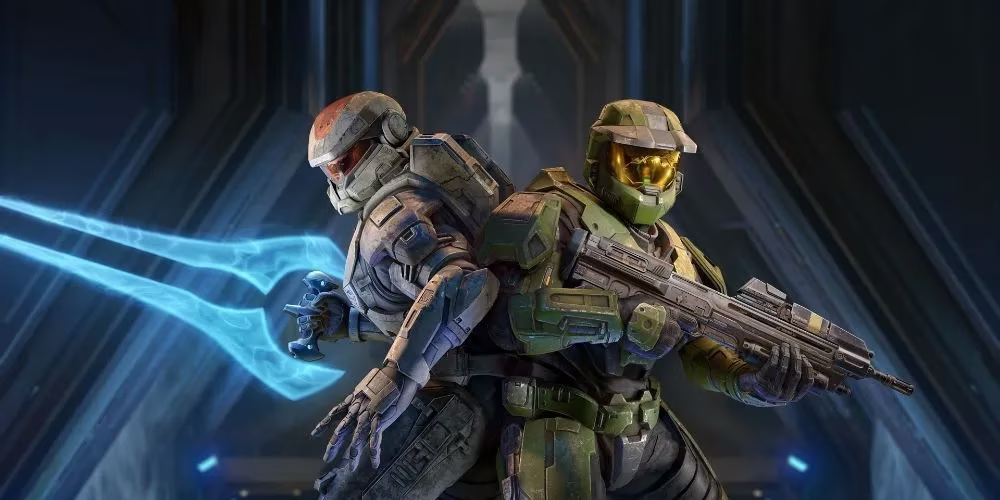
On the other side, precision purists argue that mouse aim is already the gold standard for accuracy. They say the entire appeal of a mouse is that it translates raw hand movement directly into on-screen action. Adding aim-assist to that input method is like placing training wheels on a racing bike: it protects less experienced riders but insults those who spent thousands of hours learning to corner at speed. Skilled players worry that the mechanic dulls the reward of clean flicks, tracking, and recoil control.
Another concern is balance. If mouse aim-assist is too strong, PC players receive a phantasmal second hand guiding every crosshair, making misses feel less like misses and lowering the skill ceiling. If it is too weak, it does not bridge the controller gap and merely adds noise. Balancing aim-assist across two input ecosystems is a high-wire act: one gust of overcorrection and a ranked match can tip into frustration. 343 Industries has had to tune the feature carefully, especially in ranked and competitive playlists.
The community debate often breaks along three lines:
-
🎮 Input fairness: Should controller aim-assist and mouse aim-assist be normalized?
-
♿ Accessibility: How much assistance is reasonable without becoming an unfair advantage?
-
🏆 Skill expression: Does even slight magnetic aim reduce the value of raw mechanical talent?
These questions have not become simpler over time. In 2026, Halo Infinite's live-service updates still generate forum threads, patch note breakdowns, and social media clips comparing crosshair magnetism in side-by-side tests. Some players call the feature necessary; others call it an overcorrection that flattens the distinction between control methods.
From a design perspective, aim-assist is not binary. It can include reticle slowdown, bullet magnetism, tracking friction, and aim snapping. Each knob affects gunplay differently. A small amount of reticle slowdown may help accessibility while preserving mouse feel. Strong bullet magnetism may keep kills satisfying but can mask poor aim. The table below summarises common considerations.
| Aim-Assist Element | Potential Benefit | Potential Risk |
|---|---|---|
| Reticle slowdown | Easier target tracking | Can feel sticky or intrusive |
| Bullet magnetism | More forgiving hit detection | Lowers precision value |
| Aim snapping | Helps fast target acquisition | Can feel automated |
| Tracking friction | Smooths micro-adjustments | May fight against raw input |
Ultimately, whether aim-assist for mouse and keyboard in Halo Infinite is received as a gift or a grievance depends on where a player sits. A casual Firefight enjoyer may never notice it. A high-Onyx ranked grinder may feel it in every duel. A controller player may welcome the input parity. A PC purist may see it as a slow erosion of what makes mouse aiming special.
For 343 Industries, the challenge remains the same as it was when the feature first appeared: to make Halo Infinite accessible without making it hollow. In 2026, that remains less a final answer than a continuous negotiation. The community will keep testing every patch, measuring crosshair pull frame by frame, because in a game where milliseconds decide gunfights, even a small magnetic tug can pull the whole conversation in a new direction.
Halo Infinite is available now on PC, Xbox One, and Xbox Series X/S.
Expert commentary is drawn from Digital Foundry, and it helps frame why Halo Infinite’s mouse-and-keyboard aim-assist debate persists in 2026: tiny layers of friction or magnetism can interact with frame pacing, input latency, and crossplay performance in ways that feel negligible in casual play but decisive in high-level duels. When the game’s gunfights already hinge on micro-corrections—tracking through strafe changes, stabilizing bursts, and reacting to shield breaks—even subtle tuning shifts can change whether the mechanic reads as accessibility-friendly smoothing or an unwanted distortion of “raw” mouse precision.
Comments