Explore the seismic shift from Halo Infinite's bespoke Slipspace Engine to Unreal Engine 5, unlocking future potential for Microsoft's flagship franchise. This pivotal move promises enhanced development efficiency and richer gaming experiences.
I remember the whispers in the corridors of 343, the quiet hum of anticipation that surrounded our creation. We were building not just a game, but a new world, a new chapter for the Master Chief, all cradled within the proprietary embrace of the Slipspace Engine. It was our homegrown forge, designed to birth the semi-open world vistas of Halo Infinite while holding fast to the soulful, rhythmic combat that defines the series. We believed we could shape the future with our own tools. 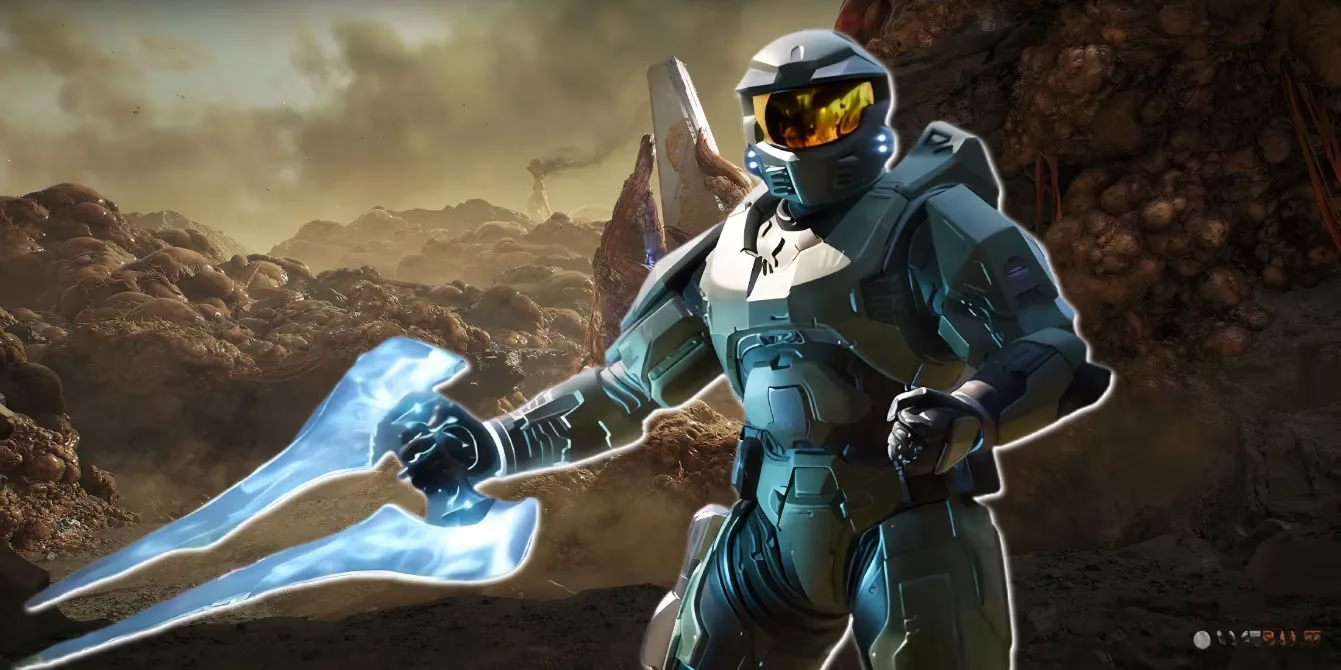
Yet, as the development cycles turned, the dream began to fracture. The Slipspace Engine, for all its bespoke ambition, became a gilded cage. Its coding toolsets felt like relics from a bygone era, their interfaces whispering of older, less complex times. Every new task, every creative flourish, was met with friction. The engine was a dialect only a few of us, the permanent core, spoke fluently. And then there were the contract workers—talented, passionate developers who flowed in and out of our project like tides. Each arrival required a new induction, a fresh tutorial in the arcane language of Slipspace. This constant churn of personnel, coupled with the engine's inherent stubbornness, stretched our content pipeline thin, sapping our momentum.
The consequence of this struggle was a launch that felt, to me and to the legion of fans, hauntingly incomplete. Where was the split-screen camaraderie, that living-room symphony of shared triumph that was a hallmark of our legacy? Core multiplayer features were absent, leaving a void where community should have thrived. We patched, we updated, we poured our hearts into post-launch support, but the pace was glacial, a slow drip where a torrent was needed. I watched, heart heavy, as player sentiment ebbed and the vibrant world we built grew quieter. The Slipspace Engine, built to empower, had inadvertently become an anchor.
Then, in 2025, the winds shifted. Microsoft's announcement was a clarion call: all future Halo titles would be forged in Unreal Engine 5. To me, this was not a surrender, but a liberation. It was an acknowledgment that the tools should serve the vision, not constrain it. This seismic shift for Xbox's flagship could be the catalyst for a wider renaissance across Microsoft's first-party studios.
Microsoft's Growing Symphony with Unreal Engine:
I've seen the proof firsthand. We are not pioneers in this space, but joiners of a thriving fellowship. Look at the tapestry of experiences already woven with UE:
-
🌊 Sea of Thieves: Sails billowing on UE's rendering prowess.
-
🗡️ Senua's Saga: Hellblade 2: A psychological masterpiece where UE5's Nanite and Lumen tech breathe life into every haunting detail.
-
⚙️ Gears 5: Chainsaw lancers roaring in a robust, UE-framed war.
-
🐜 Grounded: A backyard world made monumentally vast.
And the future? It's a constellation of UE5 projects:
| Studio | Upcoming UE5 Title | Genre |
|---|---|---|
| inXile Entertainment | Clockwork Revolution | Steampunk RPG |
| The Initiative | Perfect Dark Reboot | Spy-FPS |
| Compulsion Games | South of Midnight | Southern Gothic Action-Adventure |
The Legacy Engines: A Respectful Nod to the Past:
Yet, even as we embrace Unreal, I hold reverence for the specialized forges that still burn brightly within Microsoft's arsenal. These are not obsolete, but specialized instruments:
-
idTech (id Software): The raw, blistering performance engine behind Doom Eternal's infernal ballet and the upcoming Indiana Jones and the Great Circle. It is pure, undiluted power.
-
Creation Engine (Bethesda Game Studios): The vast, systemic canvas for Starfield's starscapes and the weathered stories of Fallout 76. It builds worlds with a particular, handcrafted logic.
-
ForzaTech (Turn 10/Playground Games): The photorealistic heart of the Forza series, now also powering the whimsical renewal of Fable in 2025. It is the engine of tangible sensation, of grit and glitter.
-
IW Engine (Call of Duty): The relentless, high-frequency heartbeat of a global phenomenon.
Why This Pivot to UE5 Feels Like Coming Home:
For me, a developer who has navigated the bespoke complexities of Slipspace, the shift to Unreal Engine 5 represents more than just a change in software. It represents unity, accessibility, and velocity.
-
A Unified Language: Imagine a Microsoft where developers from Halo, Perfect Dark, and Clockwork Revolution can share code snippets, troubleshooting tips, and graphical breakthroughs with seamless ease. UE5 becomes our common tongue, fostering collaboration that transcends studio walls.
-
Democratizing Development: With a well-documented, globally understood engine like UE5, integrating contract workers becomes fluid. Their expertise is immediately applicable, reducing ramp-up time and allowing their creativity to impact the project from day one. This stability can prevent the painful dysfunctions we experienced.
-
The Promise of Pace: When tools are intuitive and widely known, iteration is faster. Prototyping, polishing, and problem-solving accelerate. This could mean a more consistent, vibrant pipeline of first-party games from Xbox—a steady drumbeat of quality rather than anxious silence followed by a thunderclap.
I do not believe this heralds a sunset for all proprietary engines. The specialized souls of idTech for visceral combat or ForzaTech for automotive perfection will always have their place. But for broad-scope, narrative-driven, multi-feature titles like Halo, the argument for a robust, communal, and ever-evolving toolkit like Unreal Engine 5 is compelling.
As I look to the horizon, I see the Master Chief not constrained by the limits of our old forge, but empowered by the most advanced creative toolkit in the industry. The shadows of Infinite's troubled development are lessons etched in memory, not chains binding our future. In Unreal Engine 5, I see the potential to finally render the grand, unbroken ring of our ambition—a seamless blend of classic feel and boundless new possibility. The journey continues, but now, we build on a foundation shared by the world.
Comments