343 Industries' handling of the Halo franchise remains a turbulent identity crisis as fans question if the studio can steer it to success.
The landscape around 343 Industries has shifted as dramatically as a supernova’s shockwave reshaping a distant nebula. Since Microsoft’s in-house studio inherited the Halo franchise from Bungie well over a decade ago, its stewardship has been a turbulent voyage—akin to captaining a legendary starship through an asteroid field with half the navigation charts missing. What began as a torch-passing ceremony at the dawn of the Reclaimer Saga has calcified into a prolonged identity crisis, leaving fans and industry watchers asking the same urgent question in 2026: can 343 finally steer the UNSC flagship out of the storm, or will Halo remain stuck in a perpetual slipspace anomaly of its own making?
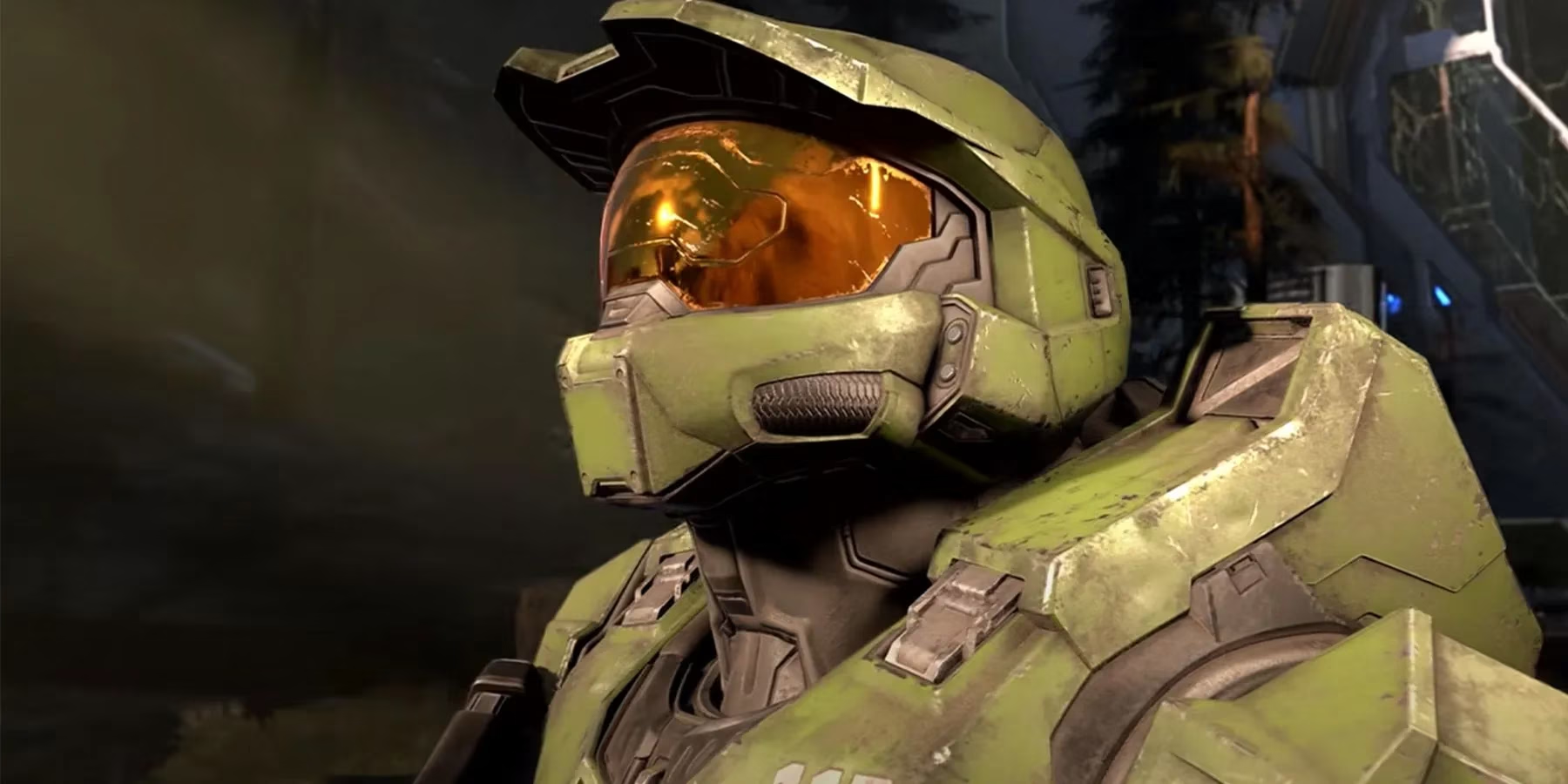
When Bungie departed Microsoft to chase the cosmic wonders of Destiny, 343 Industries was tasked with an almost mythical burden—protecting the first-person shooter that had defined a console generation. The studio’s opening salvo, Halo 4 (2012), arrived not as a timid imitation but as a confident leap into uncharted Forerunner mythologies. Its campaign explored the emotional fraying of Master Chief and Cortana, introducing the Prometheans as a formidable new enemy class that glistened like living obsidian. Many still regard that entry as the high-water mark of the new era, a moment when the series felt like a phoenix gently testing its reborn wings rather than flailing mid-air. Accompanying it was Halo 4: Forward Unto Dawn, the franchise's first live-action web series that bridged the narrative gap with surprising polish.
With Halo 5: Guardians (2015), 343 dared to fracture the iconic hero’s journey. Players were thrust into the boots of Spartan Locke, hunting a Master Chief who had gone rogue in pursuit of a rampant Cortana. The campaign’s ambition was a thunderbolt, but its execution landed as a weak spark—narrative threads dangled or snapped entirely, leaving the much-hyped Hunt the Truth audio drama as a poignant ghost of what might have been. Multiplayer, however, was not without innovation: the large-scale Warzone mode blended PvE and PvP in a package that felt genuinely fresh, albeit tainted by the REQ pack microtransactions that clung to the experience like barnacles. The controversial removal of split-screen co-op, a staple of the original trilogy, also began here, marking the moment Halo stopped feeling like a couch-game phenomenon at all.
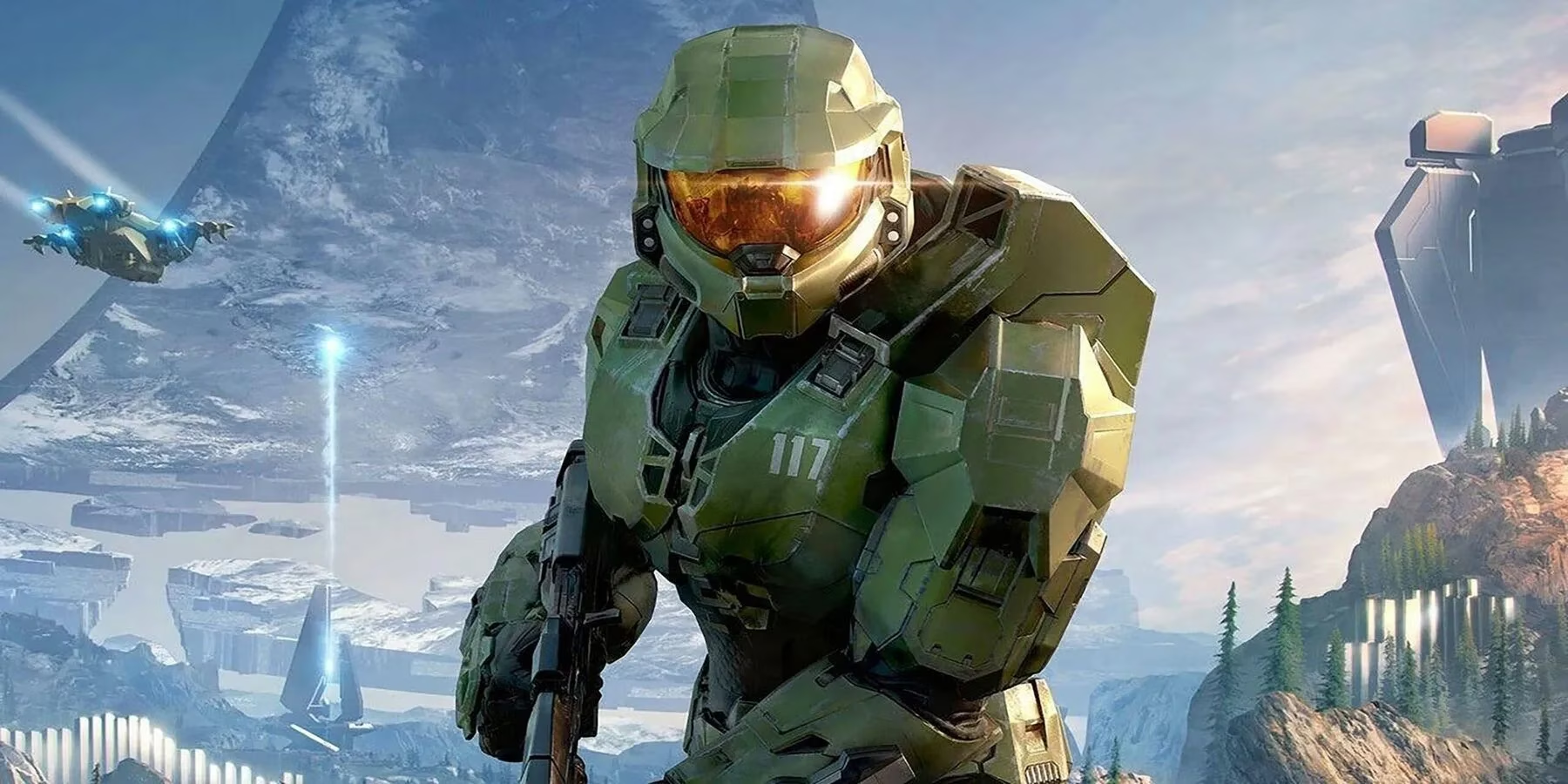
After six years of radio silence, Halo Infinite crash-landed in late 2021 with a campaign that dared to re-architect the very DNA of the series. Zeta Halo unfolded as a semi-open world, offering bases to liberate and Banished patrols to dismantle. The gunplay felt like a homecoming—a return to the golden triangle of guns, grenades, and melee—while the grapple shot injected a kinetic joy previously reserved for Titanfall. Yet that launch-day euphoria proved to be a mirage on a cracked foundation. Post-launch support in the years that followed became a masterclass in squandered momentum. Seasonal content sputtered out like a dimming hologram; beloved classic weapons, long-requested playlists, and co-op campaign functionality arrived so late that many squads had already scattered. The battle pass system, with its colorless rewards and needlessly labyrinthine customization, left the community feeling as if they were navigating a Forerunner maze built to frustrate rather than delight.
Across the wider 343 era, spin-offs and remasters have flowed, though not always evenly. Halo: The Master Chief Collection eventually metamorphosed from a disastrous launch into one of gaming’s great redemption stories. Creative Assembly’s Halo Wars 2 (2017) proved that the RTS spin-off still had teeth, while Halo: Fireteam Raven brought the fight to arcade cabinets. More recently, the Paramount Plus television series—despite its Silver Timeline designation—carved its own deeply divisive trench through fan discourse. These satellite projects have ensured the universe never went dark, yet they often felt like subsidiary stars orbiting a primary that was itself unstable.
-1.jpg)
By 2026, the ripples from the major layoffs that struck 343 Industries in early 2023 have consolidated into a very different studio structure. Reports indicate a leaner team, restructured around a core creative group with deeper integration into Xbox Game Studios’ broader ecosystem. Rumours of the long-lost Halo Infinite campaign DLC have been buried and mourned; instead, insiders whisper of a next-generation Halo project being built in Unreal Engine 5, a move that would abandon the venerable but ageing Slipspace Engine entirely. Whether that pivot will allow the franchise to break free of its cyclical controversies or simply deliver another beautiful but brittle vase remains the industry’s most persistent shroud of fog.
The past decade under 343 Industries has played out like a symphony with brilliant soloists but no conductor. Each title has arrived with a distinct melodic line—Halo 4’s intimate tragedy, Halo 5’s fractured bombast, Infinite’s lonely reconquest—yet none have cohered into a movement the whole audience could embrace. The multiplayer spheres, once the soul-tether connecting generations of Spartans, have drifted into disparate, monetization-laden echoes of the past. As the franchise stares toward 2027 and beyond, one truth hangs heavier than a Scorpion tank: the Halo name still commands a gravity field unlike almost any other in gaming, but even the mightiest gravity wells collapse if their core grows too volatile. For 343 Industries, the countdown to renewal—or irrelevance—is ticking.
📊 Key Milestones of the 343 Era
| Year | Title / Event | Notable Outcome |
|---|---|---|
| 2011 | Halo: Combat Evolved Anniversary | Promising remaster begins the transition |
| 2012 | Halo 4 | Bold narrative re-launch, strong critical reception |
| 2014 | Halo: The Master Chief Collection | Troubled launch; later transformed via patches |
| 2015 | Halo 5: Guardians | Experimental campaign divides fans; Warzone premieres |
| 2017 | Halo Wars 2 | RTS sequel finds its niche audience |
| 2021 | Halo Infinite | Open-world pivot; multiplayer struggles with live-service design |
| 2023 | Studio layoffs & leadership changes | Joseph Staten departs; DLC reportedly cancelled |
| 2025-26 | Rumoured Unreal Engine 5 project | Next-gen development quietly underway |
🔹 What Could Break the Cycle?
-
A return to feature-complete launches with split-screen, co-op, and robust Forge mode on day one.
-
A singular campaign vision that spans multiple games without soft-rebooting the narrative arc.
-
Multiplayer monetization that respects player investment rather than treating it as a resource to mine.
-
Transparent communication cadences that treat the community not as an audience to placate, but as active crew members aboard the ship.
The saga continues, and as every Spartan knows, hope is seldom the first weapon you reach for—but it’s the one that refuses to jam.
Comments