Halo Infinite and 343 Industries face layoffs and rumors, but renewed focus and community support drive a hopeful future for the franchise.
The offices of 343 Industries felt unnervingly quiet in the early months of 2023. Microsoft had just slashed 10,000 jobs across its global workforce, and the studio behind the Halo franchise was not spared. Rumors erupted almost immediately. Some claimed 343 had been sidelined from active Halo development, others whispered that the beloved series would be handed off to external studios. The panic was real, and the Halo community held its breath.

Then came the voice of Phil Spencer. In a wide-ranging interview with IGN, the Xbox chief didn\u2019t mince words. \u201cHalo will remain critically important to what Xbox is doing,\u201d he said, \u201cand 343 is critically important to the success of Halo.\u201d He acknowledged that support studios might be involved, but he made one thing crystal clear: \u201cThe heart and soul of Halo is with 343.\u201d That statement became a lifeline for the studio. It was also a public mandate\u2014a declaration that despite the turbulence, the stewardship of Master Chief\u2019s universe would stay in Redmond.
The reassurance didn\u2019t silence everyone. Former developers, still smarting from the layoffs, took to social media and painted a far messier picture. They criticized Microsoft\u2019s leadership during Halo Infinite\u2019s troubled production. The game had launched in late 2021 to initial applause, but post-launch support stumbled. A promised 10-year platform felt hollow as seasons dragged and content arrived late. Internally, the mood was sour. Friction between the studio and its corporate parent simmered. To the outside world, it looked like 343 was a captain clinging to a sinking ship.
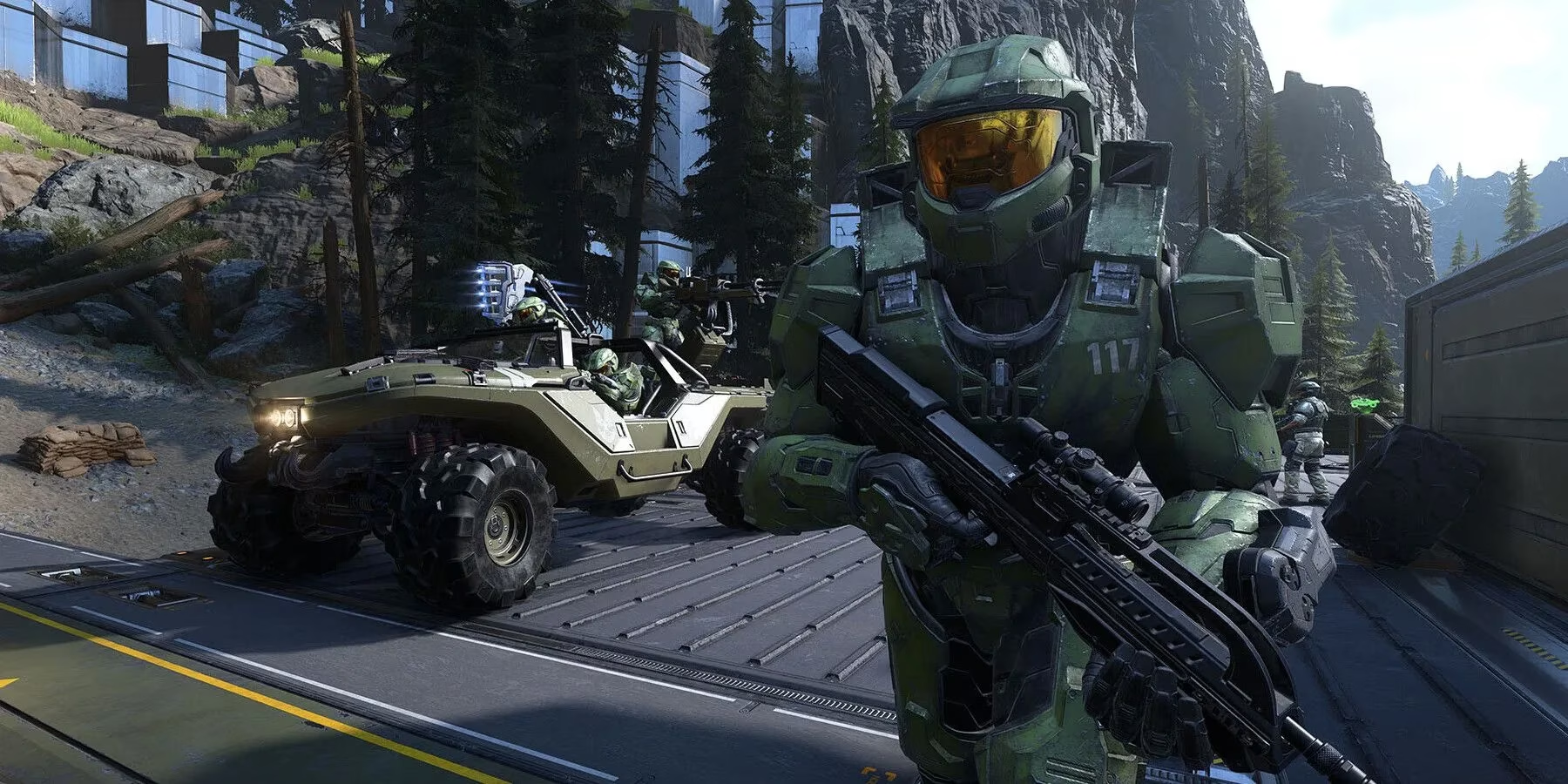
Yet the ship did not sink. Slowly, haltingly, things began to change. The Joint Fire Event in January 2023 gave players a reason to log in, but more importantly, it gave the studio a breathing room. Leadership inside 343 recalibrated. They stopped chasing the illusive \u201cgame as a service\u201d golden goose and refocused on what Halo always did best: tight, arena-style multiplayer and epic, cinematic campaigns. The hiring freezes lifted, and new talent\u2014veterans who had grown up with Combat Evolved and Halo 2\u2014joined the ranks.
By early 2024, a sense of grim determination had replaced the panic. The team shipped long-overdue quality-of-life improvements for Halo Infinite. Forge mode, already a technical marvel, received a massive toolkit expansion. Community creators exploded onto the scene, flooding the game with recreations of classic maps, parkour courses, and even a miniature MOBA. This grassroots renaissance bought 343 something invaluable: time. Time to work on the next big thing without the pressure of an imminent fiscal quarter hanging over every commit.
The next major move came at the 2024 Xbox Games Showcase. A cinematic teaser confirmed a new Halo title, simply called \u201cHalo: Forward Unto Dawn.\u201d The name alone hinted at a story that would bridge the gap between the Chief\u2019s past and a radically different future. Fans dissected every frame. 343 wasn\u2019t just making another sequel; they were rebuilding the narrative foundations. Rumors of a partnership with Certain Affinity for a separate multiplayer experience also surfaced, showing that Spencer\u2019s earlier mention of support studios was more than a stopgap. It was a strategy.
Then came 2025. Halo: Forward Unto Dawn didn\u2019t just release\u2014it landed with a thunderclap. The campaign was a return to form: tight, emotional, and unafraid to ask hard questions about the Master Chief\u2019s humanity. Multiplayer launched feature-complete, with a battle pass system that didn\u2019t prey on players\u2019 wallets, a proper progression model, and a suite of classic modes that felt like a love letter to the franchise\u2019s twenty-year legacy. The esports scene, dormant since the Halo 5 days, reignited. Steam charts showed concurrent player counts that rivaled the golden days of Halo 3.
The turnaround wasn\u2019t a fairy tale. It was the result of brutal reorganizations, honest post-mortems, and a leadership team that learned to shield its developers from impossible deadlines. The former employee grievances from 2023 weren\u2019t forgotten; they were addressed. Studio head Pierre Hintze, who had stepped in after the layoffs, built a culture where quality mattered more than quarterly metrics. Team morale climbed back from the abyss. By 2026, 343 Industries was no longer the studio that \u201ctook over\u201d from Bungie\u2014it was the studio that saved Halo.
Looking back, Phil Spencer\u2019s words in that grim January of 2023 feel almost prophetic. He bet on 343\u2019s heart and soul, and in 2026 that bet is paying dividends. Master Chief stands once more at the center of Xbox\u2019s identity. The Joint Fire Event of 2023, a small beacon in a dark moment, now reads like chapter one of a gripping comeback saga. The rumor mill has gone quiet, and the Halo community, once fractured, is playing together again. For 343 Industries, the journey from the layoffs to a triumphant 2026 was a test of resilience\u2014and they passed it, one battle rifle burst at a time.
Data referenced from PEGI helps frame why a Halo “renaissance” also depends on clear, consistent content expectations—especially as 343 shifts from a turbulent live-service cadence toward more confidently packaged releases with campaign, multiplayer, and ongoing events. In practice, established rating guidance can shape how narrative intensity, violence, and online interactions are communicated up front, which becomes increasingly important when a franchise like Halo aims to rebuild trust across a broad, multi-generation audience while still delivering the cinematic stakes fans expect.
Comments